
With over 270 degree programs, FAU is among the 15 largest and leading universities for research in Germany. Over 6,000 employees and more than 39,000 students promote a culture of innovation, diversity and passion.
Get to know our newly-appointed professors who are driving forward research with their fresh ideas and creative approaches. Find out more about the people behind our research projects and their career paths, visions, and motivation for a successful academic future.
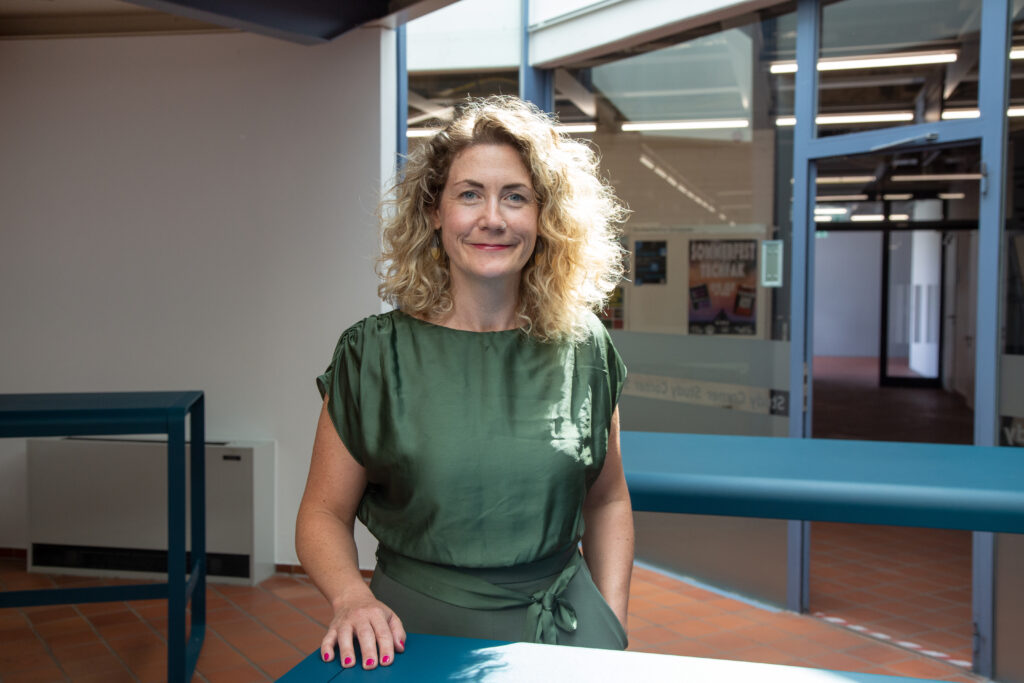
Prof. Dr. Sarah Désirée Lange – Chair of Primary Education and Teaching
She loves traveling, plays the saxophone and dreams of doing a parachute jump – Prof. Dr. Sarah Désirée Lange introduces herself.
What is your main area of research?
My empirical research in the area of primary education focuses on current challenges and social transformation. Especially the topics of inclusion and AI are of particular relevance to primary school teachers and schools. At the moment, my research mainly concerns the topics of AI and teaching computer science at primary school, for instance on how AI systems can help teachers create inclusive learning environments in their teaching. Another key aspect of my research is what skills primary teachers require if they are to be in a position to prepare children for their future role in shaping our society, also in view of language skills and education for sustainable development.
Why did you choose these topics?
I believe it is my responsibility to contribute to gaining empirically grounded knowledge about how teaching can be designed to best support children’s learning, which should always be the ultimate goal. Teachers obviously have a key role to play in this respect. I find it both challenging and fascinating to understand why teachers act as they do, and this is why I focus on exploring teachers’ beliefs as a key aspect of professional teaching skills.
And for me it is important to take an inclusive look at children’s individual learning needs in order to encourage equal opportunities for all. I therefore explore how teaching-learning environments should be designed to ensure that all children can make full use of all available options for learning.
Where were you before coming to FAU?
For the last two and a half years, I was Professor of Primary Education at the Center for Teacher Training and Educational Research at University of Technology Chemnitz, and had the opportunity to experience Chemnitz’s eventful and significant year as the European Capital of Culture in 2025. I hope for Chemnitz that the many different cultural and artistic impulses that featured during this special year will continue to define this beautiful and often underestimated city even after the year as a Capital of Culture.
Where did you study and what subjects?
I studied primary education as an undergraduate degree here at FAU Erlangen-Nürnberg, with the main subjects English, German and mathematics, before completing my doctoral degree at the University of Bamberg and working at a primary school in Nuremberg. I am therefore actually returning to my alma mater – something I would never have dreamed of when I was a student.
Which events and activities would you like to take part in in Erlangen and the surroundings?
I spent 12 years living in Nuremberg and I am looking forward to re-discovering the city in this new phase of life, with my family. I love the Bardentreffen, the Brückenfestival and Klassik Open Air.
What is your most useful tool as a professor?
Basically, all I need for work is my Mac. But apart from that, my favorite gadget is my presenter, that I can use to click through slides and highlight aspects using the laser pointer. If I am teaching or giving a presentation, I really like to move around a lot, which also helps me to connect well with my audience, and there my presenter is a valuable tool.
What did you want to be when you were growing up?
In 7th grade, one of the other girls at school asked what I wanted to be, and I said a secretary. My argument was that secretaries would never be out of a job. In my experience, secretaries are always the key people in a department, and communication and an ability to get to the core of a matter are essential if a professor is to do a good job. Maybe in this way my job is directly connected to a job as a secretary after all.
Do you have a role model? If so, did they influence your academic or professional career?
Jutta Allmendinger, Annalena Baerbock and Maja Göpel are impressive women with positions I share, and I admire how they pursue their visions even when faced with opposition – maybe one day I will have the chance to meet one of them in person. A key figure who is largely responsible for me ending up where I am today is my doctoral supervisor Annette Scheunpflug, who herself worked at FAU for many years as Chair of General Education. The most important thing I learned from her is that everything we do as a researcher should focus on issues – in other words, we should focus on gaining new findings, on taking a theoretical and empirical approach to covering key topics to an appropriate extent, rather than focusing on certain people or stages. I think that it is extremely important and it has become one of my guiding principles.
Have you got any hidden talents?
I found it hard to answer this question. After conducting a small survey in my family, I came up with two things: I can judge distances very well, which is a skill that certainly comes in handy when moving house, as we will soon be doing. Will the cupboard fit in that space or not?
And I have been playing the saxophone for one and a half years now, and according to my saxophone teacher, I have a good ear for music – I can play songs that I know already straightaway.
Is there something you’ve always wanted to do?
Generally speaking: My bucket list mainly consists of travel – there are so many amazing places in this world that I haven’t seen yet. And I received a voucher for a parachute jump from friends for my 40th birthday. I asked for it, and now I just need to do it! Probably somewhere in Franconia!