
Joint rescue operation launched after FAU Roman boat runs aground in Croatia
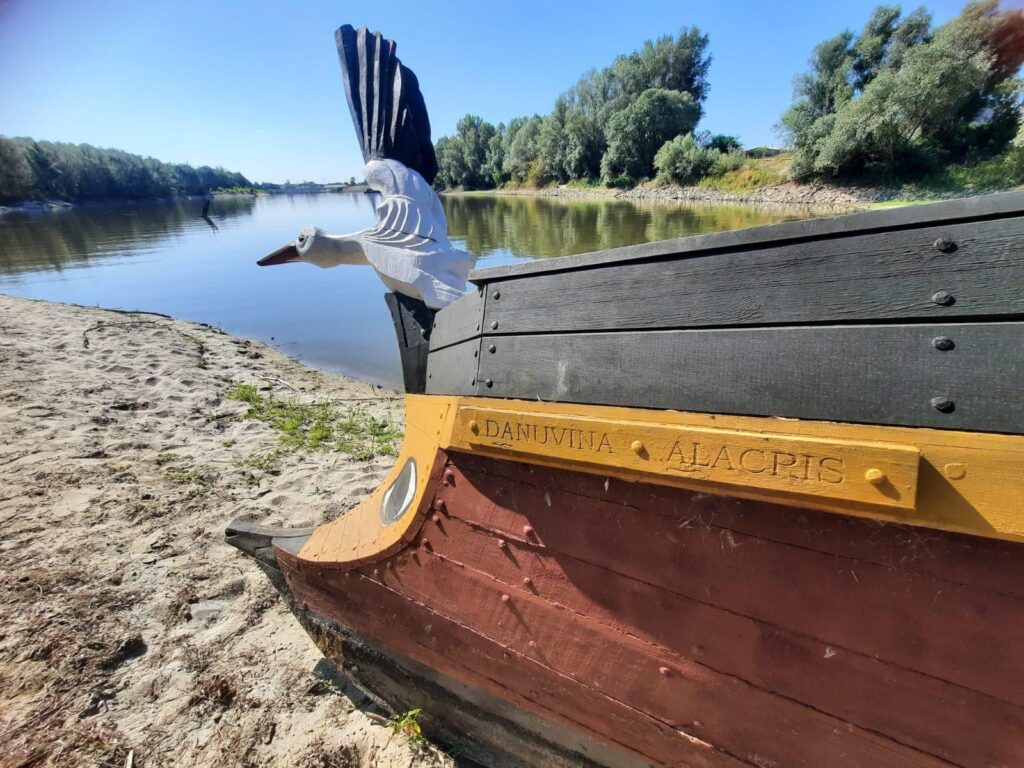
A sorry sight under the burning sun. No-one knows how long the boat has been lying abandoned on the banks of the Drava River in eastern Croatia. The bow and midship are lying downhill, with the stern hanging in the air. The keel is beginning to bend under its own weight. The Danuvina alacris, the second reconstruction of a Roman patrol boat from Friedrich-Alexander-Universität Erlangen-Nürnberg (FAU), risks being lost forever. But help is on the way: Professor of Ancient History at FAU Prof. Dr. Boris Dreyer has now enlisted the help of the Croatian army and volunteers to rescue the boat he built with EU funds and bring it back to the boatyard at Schlungenhof on the Altmühlsee lake. There, he hopes to be able to restore the Danuvina alacris.
Rapid aid in Croatia
Built from 2020 to 2022 as part of the EU Interreg project “Living Danube Limes”, the Roman boat was handed over to Osijek in Croatia in mid April after an overhaul last winter. The loan followed on from a series of loans to other states along the Danube since 2024: Austria, the Czech Republic, Slovakia and Hungary; it should have been a matter of routine. But then a dockworker from Osijek sent Boris Dreyer a photo that immediately set alarm bells ringing: It showed the Danuvina in a desolate state, abandoned on the bank of the River Drava, a tributary of the Danube River.

“At first, I was dismayed,” reports the FAU professor. “I could hardly believe it when I was sent the photo at third hand.” Dreyer then contacted the German Embassy in Zagreb on August 4. The German Military attaché for Croatia and Montenegro, Lieutenant Colonel Burkhard Weber, promptly contacted the Croatian army, who agreed to help. On August 6, Boris Dreyer set off for Croatia, on August 10 the Croatian Ministry of Defense then promised the support of the Croatian army. “It was an extremely unbureaucratic procedure,” said Boris Dreyer. “I am very pleased and grateful that Colonel Weber agreed to help us so quickly and Minister of Defense Ivan Anušić promised us the support of the Croatian army in order to avert the impending catastrophe for the EU project with a joint German-Croatian effort.”
Danger for the wooden reconstruction
Once he arrived on site, the true extent of the damage became apparent to Boris Dreyer: Due to neglect and low water levels, the 18 meter long reconstruction with a weight of 5 tonnes had run aground on the bank of the River Drava and had been lying there for some time. The keel was starting to bend under its own weight. The wood it was built with has dried out, shrunk and started to crack; this may herald the end for a wooden boat. Gaps are appearing between the planks, the paint is starting to flake off. The interior is no better. It is apparent that no-one has taken care of it for quite some time.
Dreyer and his “first responders” began from August 7 to secure the Danuvina, first supporting the stern to stabilize the keel, before covering the boat exposed to the burning sun with a tarpaulin. However, it was clear that salvaging the boat would entail a major effort. “In order to continue securing the Danuvina alacris, we had to first open an access route to the river bank,” Boris Dreyer explains. First of all, Croatian army engineers cleared the way with an excavator. Props had to be set up along the side of the boat, and the boat had to be watered twice a day to make the wood swell again. The Croatian army engineers also built sliding blocks that were slid under the boat’s keel in order to be able to re-float it on the water. On August 19, the Croatian Defense Minister Anušić and the Deputy Commander of the Croatian Army, Brigadier General Valentin Skroza visited the location to view the progress of the works.


What will happen next?
“The Danuvina alacris must be set afloat again, as it is not possible to lift the Roman boat onto a trailer here at the banks of the Drava River,” explains Boris Dreyer. “We will take the opportunity to record where water is leaking into the boat.” The date is set for August 26, and until then the boat will be watered every day. The next day, a tow boat from the Croatian army will tow the wooden boat into the harbor in Osijek. There it will be loaded onto a trailer with the help of FAU volunteers, dockworkers and members of the Croatian and German armies. Boris Dreyer will then drive the Danuvina alacris back to the Altmühlsee and will try his best to restore the ship with the white stork on its bow. He hopes that the boat will continue to remain available for scientific tests, bringing the joint European project to a successful conclusion.
Contact
Prof. Dr. Boris Dreyer
Professorship for Ancient History