
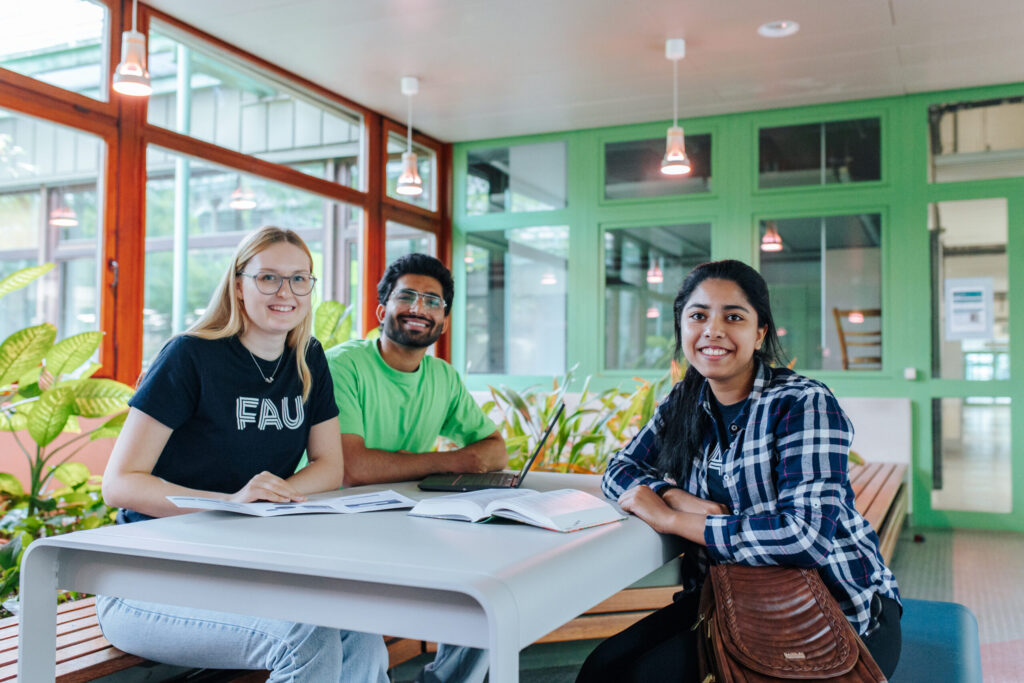
The foundation Stiftung Innovation in der Hochschullehre is providing funding for a transdisciplinary FAU project for sustainability in teaching.
The challenges of the 21st century – climate change, loss of biodiversity, social inequality, health risks and questions exploring how to achieve a sustainable economy – are complex and inextricably linked. If we are to overcome these considerable challenges, new forms of collaboration between science, society, the economy and politics are essential. Universities play a key role. They educate the experts, decision makers and architects of tomorrow’s world today and create opportunities for innovation and social transformation. This is the guiding principle behind the project Transdisciplinary Education for Responsible Action (TERRA) at Friedrich-Alexander-Universität Erlangen-Nürnberg (FAU). The foundation Stiftung Innovation in der Hochschullehre is providing nearly 3.5 million euros in funding for the project.
What do students learn through the FAU project TERRA?
TERRA understands sustainability as the interplay of ecological, economic and social responsibility. “For this interplay to become possible at all, our key focus is on transdisciplinarity,” explains Prof. Dr. Svenja Bedenlier, speaker of the Management Committee of FAU Competence Center Teaching. “The aim is that students not only learn within the confines of their own disciplines, but work instead on real-life issues together with other stakeholders from science, the economy, politics and society.” This will create learning spaces where scientific expertise merges with social practice. “In this way, the project combines scientific analysis with a concrete social impact and creates opportunities for learning in which students can experience self-efficacy and take on responsibility,” Svenja Bedenlier continues.

“The aim is that students not only learn within the confines of their own disciplines, but work instead on real-life issues together with other stakeholders from science, the economy, politics and society.”Prof. Dr. Svenja Bedenlier
In this way, students not only learn specialist knowledge, they also acquire in particular skills such as:
- Systematic thinking
- Critical thinking and reflection
- Problem-solving skills
- Team skills
- Sense of responsibility
- Tolerance of ambiguity
- Skills in shaping a sustainable future
In other words, future skills for an increasingly complex world.
Other aims of the TERRA project
The main aim of TERRA is to fully integrate education for sustainable development (ESD) into studying and teaching in the long-term. Sustainability topics along the lines of the Sustainable Development Goals (SDGs) of the United Nations are to be integrated systematically into degree programs. Other aims of the project are to develop innovative transdisciplinary teaching and learning formats, encourage students to play a more active role in shaping teaching, and establish a university-wide sustainability certificate. Finally, FAU would also like to develop transferable models for other universities.
Sustainability as a strategic topic at FAU
“The project is directly linked to FAU’s strategic approach,” comments Prof. Dr. Andrea Bréard, Vice President Education at FAU. “Sustainability is one of the key cross-sectional topics at FAU and is anchored in our university strategy.” For this reason, TERRA is being implemented as a joint project involving central institutions, the faculties and chairs as well as students themselves, with its integration across the whole of the university being one of the project’s distinguishing features.
Executive Board
The Executive Board, represented by Vice President Education Prof. Dr. Andrea Bréard, is responsible for the strategic aspects of the project and will provide support for the results becoming integrated across the university as a whole over the long term.
FAU Competence Center Teaching
FAU Competence Center Teaching (Prof. Dr. Svenja Bedenlier) is responsible for coordinating and managing the TERRA project. That apart, it is also responsible for the planned ESD lab, providing support for university-level teaching, evaluations, and assessing the impact of the project.
It will provide support for developing innovative teaching and learning formats, for training lecturers and for integrating digital teaching and learning methods including media production, learning management systems and accessibility.
Faculties and degree programs
The involved faculties and degree programs will coordinate closely to implement the subject and curriculum-related aspects of the project. They are responsible for enhancing existing modules, piloting new teaching formats, and incorporating them into the curricula in the long term.
Students involved in designing programs
Students are not only the target group, they are also active partners in the project. Via the General Student Committee, the steering group, sounding boards and dialog groups they can contribute their perspectives to the development, implementation and evaluation of the measures.
Green Office at FAU
The Green Office will help to draw up an inventory of existing courses with a focus on sustainability, activate internal university networks, and become involved in knowledge transfer and outreach measures. Existing formats such as the lecture series on sustainability will be integrated into the certificate structure.
Center for Applied Philosophy of Science and Key Qualifications (ZIWIS)
ZIWIS will contribute its expertise in the areas of future skills, the philosophy of science, and key qualifications. It will develop new courses and support the anchoring of transdisciplinary skills in the sustainability certificate.
Chair of Science, Technology and Gender Studies
Prof. Dr. Maria Rentetzi’s chair will work in collaboration with Prof. Dr. Antje Kley and PD Dr. Annette Keilhauer to contribute their expertise in gender, diversity and social transformation in science and innovation, thereby strengthening in particular SDG 5 (gender equality).
Academic Affairs and quality management
Academic Affairs at University Administration and the offices responsible for quality management and teaching at the faculties will be responsible for the organizational and legal aspects involved in integrating the new modules and sustainability certificate.
What is the significance of TERRA for the region?
As a university which offers the entire spectrum of academic disciplines and has a strong innovation ecosystem in the Nuremberg Metropolitan Region, FAU has excellent prerequisites for transdisciplinary collaboration. The project will create new connections between the University, companies, local authorities, NGOs, associations and civic organizations, which may in turn lead to the creation of innovative opportunities for learning and shaping the future that will have an impact far beyond FAU.
The partner networks include, among others, the Bavarian Center for Sustainability in Higher Education (BayZeN), the Nuremberg Chamber of Industry and Commerce, the Erlanger Klima-Allianz (Erlangen Climate Alliance) and the international partners in the EELISA network.
Contact
Sonia Hetzner
FAU Competence Center Education (FAU Education)