
FAU President focuses on a culture of enablement and wants to nurture talent early
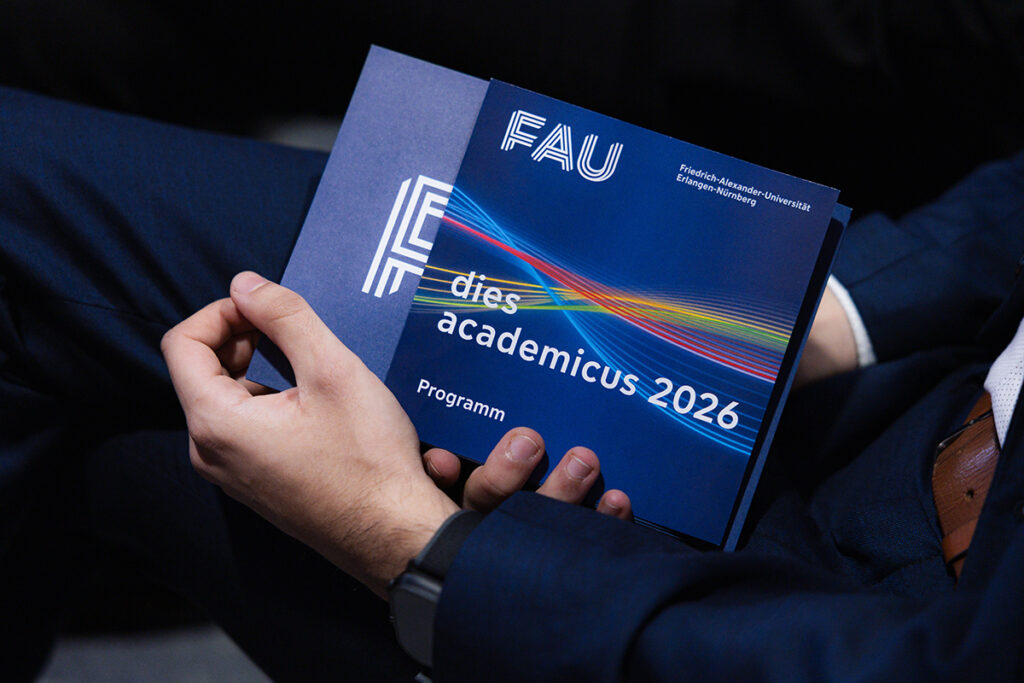
On the 283rd anniversary of Friedrich-Alexander-Universität Erlangen-Nürnberg (FAU), President Prof. Dr. Joachim Hornegger emphasizes the appeal of the university: FAU’s attractiveness arises from outstanding people, strong research, and the ability to nurture talent.
“Work with the best. Learn from the best. And measure yourself against the best.” This was the advice Prof. Dr. Joachim Hornegger, President of FAU, gave to ten students in the spring over a shared lunch in the cafeteria. At the Dies academicus 2026 celebration, he delivered this message to the entire university: FAU wants to be a magnet for people who want to make things happen. This takes not only outstanding researchers and instructors, but also a university that identifies talent early, entrusts it with responsibility, and opens up prospects.
Discovering and nurturing talent
Once again, FAU can point to successes in supporting researchers in the early phases of their careers: 861 doctoral candidates completed their doctoral degrees last year. With 14 research training groups funded by the German Research Foundation (DFG), FAU is at the top nationwide. In the most recent funding round, all four applications were successful.
Further information:
FAU wants to improve its support structures to allow early-career researchers to realize their ideas more quickly. Progress can be made by identifying talent earlier, entrusting early-career researchers with responsibility sooner, and creating reliable career prospects. Measures include a Dean’s List for particularly high-achieving students, the expansion of early-career research groups, and the tenure track as a regular path to a professorship.
Six ERC Grants and cutting-edge research with impact
“FAU has again shown what it is made of,” emphasizes Joachim Hornegger in his speech. “With the TERRA teaching project, we have secured almost three and a half million euros so that our students can help solve the problems of our time. In patent applications, we are one of the three leading universities in Germany.”
FAU has also achieved important successes in research funding over the past year. Within twelve months, it was able to secure six grants from the European Research Council (ERC). Prof. Dr. Andrea Bréard received an Advanced Grant, and Prof. Dr. Ricardo Grieshaber-Bouyer and Dr. Angelos Karlas were awarded Starting Grants. Prof. Dr. Bernhard Kainz, Prof. Dr. Alessandro Del Vecchio, and Prof. Dr. Gregor Fuhrmann received Proof of Concept Grants, which will help move their research from the lab into practice.
Further information:
Right conditions for cutting-edge research
However, for FAU to continue attracting the best minds from around the world, Hornegger says that the conditions have to be right. He therefore makes a clear appeal to policymakers: The university needs adequate core funding and long-term prospects for its employees. “Cutting-edge research does not move at the same pace as budget years,” warns the president. Ongoing tasks must be secured through permanent positions, especially in technology and administration. The housing situation is also an important consideration: What good is the best place to study if students can’t find an affordable room? Bavaria and the municipalities must rise to this challenge.
Deciding faster, enabling more
It is not only policymakers who must create better conditions. The university itself must also change, Hornegger concedes. He wants to shorten decision-making paths, shift responsibility more toward where problems are solved, and not stall good ideas. His goal is a new culture of enablement. This also includes recognizing problems early and tackling them consistently. The feedback from students and staff must be heard – regardless of whether it is voiced publicly or in personal conversation. “We can only live our spirit of innovation if people dare to voice an unfinished idea.“
An innovation-driven university also needs breathing space: in its buildings as much as in people’s minds.
Congratulations from policymakers
On behalf of policymakers, Dorothee Bär, Federal Minister of Research, Technology and Space, Markus Blume, Bavarian State Minister of Science and the Arts, and Joachim Herrmann, Bavarian State Minister of the Interior, extend their congratulations to FAU.
Research Minister Bär

Dorothee Bär, Federal Minister of Research, Technology and Space, states in her video message: “Since 1743, Friedrich-Alexander-Universität has stood for research and teaching that are excellent in method and often groundbreaking in their results. FAU is thus a pillar of our society and our economy – through the training of skilled professionals, through its contribution to our scientific landscape in basic research, the natural sciences and engineering, medicine, and the humanities and social sciences. FAU stands for outstanding interdisciplinary achievements. Its researchers bear social responsibility and shape our country’s innovative strength. How fortunate that they exist. Congratulations on the 283rd founding anniversary.”
Science Minister Blume
Markus Blume, Bavarian State Minister of Science and the Arts, says in his video message: “Even in the 283rd year since its founding, FAU has once again shown what it means to be the best: It is Germany’s number one in securing research training groups and a Bavarian flagship for early-career support. Worldwide, it is also at the top in patents and industry collaborations. That is more than a scientific success: FAU is a frontrunner in innovative strength. With Prof. Dr. Joachim Hornegger at the helm, the flagship university from Middle Franconia is setting a course for continuity at the top. Dynamic and determined, he will carry the success story of “his” FAU forward into a third term. The Free State of Bavaria is investing around two billion euros in the comprehensive structural renewal of FAU by the end of the decade. And here, with the Center for National High-Performance Computing, we are building the largest AI computing infrastructure at a university in all of Germany. Ad multos Annos!”

Interior Minister Herrmann

Joachim Herrmann, Bavarian State Minister of the Interior, states in his opening speech: “Today we celebrate the birthday of a bright beacon of science and research and at the same time the start of an unprecedented success story. The appeal of FAU stems not only from the university itself but equally from its close connection with industry and the merits of the surrounding region; international talents choose more than a university – they look closely at the entire living, working, and innovation ecosystem. The economic strength, safety, international character, and high quality of life in Erlangen and the Nuremberg Metropolitan Region therefore contribute directly to FAU’s competitiveness.”
Students’ Representatives
Vincent Hennecke and Finnja Zuber extend congratulations on behalf of the student body. It is important to them that FAU is not only a place for the best but also one where a sense of togetherness prevails: “Through projects such as ‘Mental Health First Aid,’ FAU shows: At a university, it’s not just about performance, but also about the people behind it. And here at FAU, no one is alone.” At the same time, they still see a need for action regarding the university’s infrastructure: “In some lecture halls, you now need an umbrella rather than a projector. What we really need is stable, permanent core funding instead of endless prestige projects. If you own a house you also have to be able to pay for the roof.” They also care about openness and affordability for international students: “A home for the world’s best minds shouldn’t come with a price tag. Anyone who wants to attract the best talents in the world shouldn’t select them by their bank balance.” For FAU’s birthday, they wish for “a roof that is a little more watertight by next year, and a university where everyone who learns, teaches, and works here can feel at home. No one can achieve this alone, but together we can accomplish a lot.”
Keynote: Using AI to make ancient texts readable again
The 2026 keynote was delivered by Dr. Vincent Christlein from the Chair of Pattern Recognition at FAU. Together with an international research team, he has secured one of the prestigious ERC Synergy Grants for the project “UnLost”, where he is using AI-assisted reconstruction to decipher ancient papyrus scrolls. The fact that a researcher from the non-professorial academic staff achieved this success shows, as FAU President Hornegger says: “To compete at the top of the world stage, you don’t need a professorship, but good ideas.”
The Herculaneum scrolls, carbonized during the eruption of Vesuvius almost 2,000 years ago, are among the most significant surviving written records of classical antiquity. Much of their content is still inaccessible because the delicate scrolls cannot simply be opened. The UnLost project uses modern imaging techniques and artificial intelligence to digitally reconstruct the papyrus scrolls, analyze their structures, and make hidden texts visible. In his keynote, Vincent Christlein offers insights into the challenges and opportunities of scientific work at the intersection of computer science, image processing, and classical studies, and shows how innovative technologies help make unique records of antiquity accessible for research.
Further information:
FAU Innovators 2026
FAU hosts its anniversary celebrations as an opportunity to shine the spotlight on its particularly creative thinkers: the FAU innovators. They are honored for their innovative strength, in the hope that they will act as role models to inspire others.
New therapies for autoimmune diseases
Prof. Dr. Ricardo Grieshaber-Bouyer is being honored for his research on new treatment options for severe autoimmune diseases. The professor of Clinical Systems Immunology investigates how immune cells differ, what role this diversity plays in chronic inflammation, and why disease courses vary from person to person. One particular success was the treatment of a patient with Graves’ disease, an autoimmune disease in which antibodies trigger an overproduction of thyroid hormones. By using medications originally developed to treat blood cancer, he was able to fight the disease-causing antibodies and push back the inflammation of the thyroid. His work laid the foundation for a new class of drugs for severe autoimmune diseases. Together with partners from pharmaceuticals and biotechnology, he is testing next-generation active substances in clinical trials in order to bring innovative therapies to patients in the long term.
Strong backup for outstanding research
Dr. Christian Schmitt-Engel and his team at Research and Early Career Support are being honored for their contribution to promoting excellent research at FAU. They support researchers in preparing demanding collaborative research proposals and purposefully develop research concepts further so that they meet the requirements of the respective funding programs without losing their innovative strength. Together, they help FAU researchers turn novel ideas into successful research projects and advance academic careers. At Research and Early Career Support in the University Administration, 16 staff members pool their expertise on research processes and academic career paths. Researchers benefit from the long-standing experience of the team, whose members themselves often come from academia. The quality of this work is consistently praised, especially in reviews by the German Research Foundation (DFG).
Early warning system for the energy transition
Dr. Eva Buchta is being honored for her innovative contributions to the stability of power grids. She studied Energy Engineering and Electrical Power Engineering at FAU before earning her doctoral degree in electrical engineering at TU Darmstadt. She wrote her doctoral thesis at Siemens, where she now works as a research scientist in the area of “Sustainable Energy and Infrastructures.” In her research, Eva Buchta developed an early warning method that helps prevent overloads and limit violations in the power grid. To do this, the system combines real-time measurements with historical data and forecasts in order to assess the grid load precisely. This is especially important because grid load is constantly changing due to new consumers such as electric cars and heat pumps, as well as renewable energy sources such as photovoltaics and wind power. For her doctoral thesis, she was named “Siemens Inventor of the Year” in 2024. In 2025, Capital magazine included her in its “Top 40 under 40” list.
The event will be recorded and available on fau.tv as of November 11.


