
With over 270 degree programs, FAU is among the 15 largest and leading universities for research in Germany. Over 6,000 employees and more than 39,000 students promote a culture of innovation, diversity and passion.
Get to know our newly appointed professors who are driving forward research with their fresh ideas and creative approaches. Find out more about the people behind our research projects and their career paths, visions and motivation for a successful academic future.
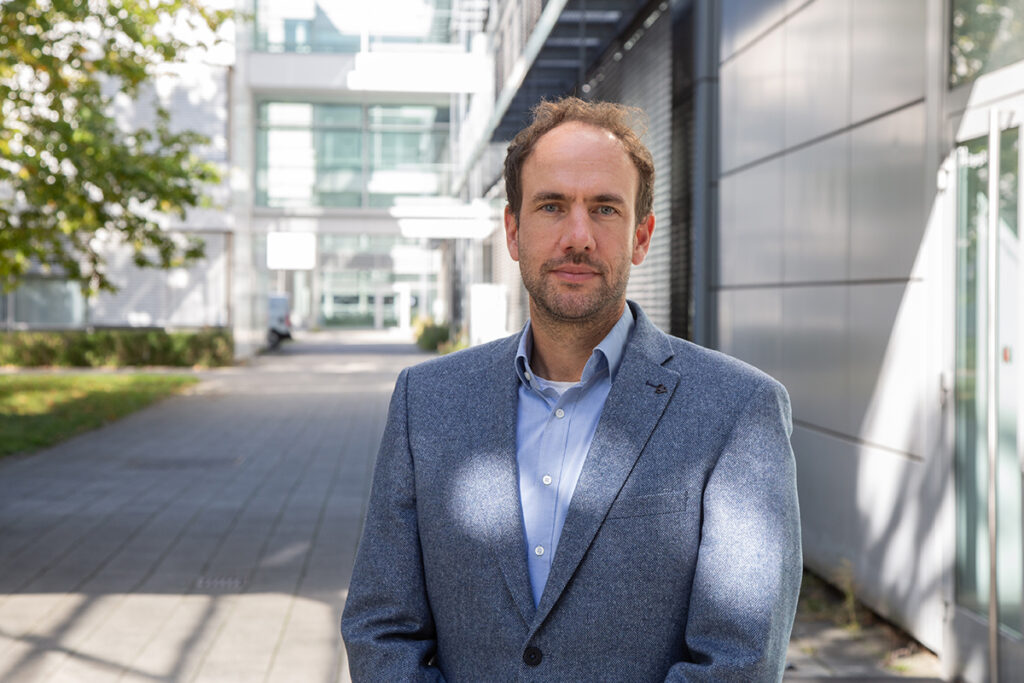
Prof. Dr. Björn von Eyss – Professorship for Biochemistry and Molecular Medicine
He conducts research into how cells become dysregulated and the role of the Hippo signaling pathway. Prof. Dr. Björn von Eyss introduces himself.
What is your main area of research?
In my research, I investigate how what is known as the Hippo signaling pathway influences the onset and progression of cancer at several levels: from the individual cell to its interaction with surrounding tissue and the immune system. A key focus is on how this alters the activity of certain genes and what consequences this has for tumor growth. We hope to use modern genetic screening methods combined with preclinical mouse models to derive new approaches for treating cancer.
Why did you choose these topics?
Even as a student, I was fascinated by the regulatory mechanisms behind gene expression, in other words how it is decided which genes are switched on or off and how this becomes imbalanced when a tumor develops. My attention turned to the Hippo signaling pathway while I was a postdoc, as it affects this very interface: Using the transcription regulators YAP and TAZ, it directly regulates which genes in the cell are activated. This connection – a key growth signaling pathway that drives the onset of cancer via gene regulation – has remained the focus of my work ever since.
Where were you before coming to FAU?
From 2016 until I joined FAU, I was head of the research group on Transcriptional Control of Tissue Homeostasis at the Leibniz Institute on Aging in Jena. My group not only investigated the role of the Hippo signaling pathway in cancer development, but also how it can be used to improve regeneration in old age. The transcription regulators YAP and TAZ are essential for regeneration, and tumors hijack this genetic program to be able to grow more aggressively, which is also clinically relevant when considering the inhibition of this signaling pathway in cancer therapy.
Where did you study and what subjects?
I studied human biology in Marburg. My major subjects were molecular biology and human genetics, and my minor subject immunology.
Which events and activities would you like to take part in in Erlangen and the surrounding area?
I haven’t made any plans yet. First of all, I’d like to explore Erlangen and the local area, and then we’ll take it from there…
What is your most useful tool as a professor?
My laptop and its calendar.
What did you want to be when you were growing up?
When I was roughly ten years old I fancied becoming a chef, but I became interested in science and research quite early on. I definitely still enjoy cooking, but my children are sometimes more critical than any Michelin inspector.
Do you have a role model? If so, did they influence your academic or professional career?
I was very impressed by the biography of Eric Kandel – a neurobiologist who won the Nobel Prize in Medicine in 2000. He describes how very early in his career he decided to research classical conditioning using the mollusk Aplysia, although several colleagues advised him against it, as they did not believe that such a simple organism was a suitable model for understanding memory. It was an approach that accompanied him across his entire career and showed me that a researcher needs two things more than anything else: A vision and the stamina to pursue it.
Have you got any hidden talents?
It is maybe not a hidden talent, but during the time I was writing my doctoral thesis in Berlin, I actively played electric guitar in bands. That has had to take a backseat due to my career and family, but the guitar is still there. Maybe I’ll get around to playing it again more often sometime.