
FAU is developing new approaches for municipal flood protection in the EU MUDCAP project
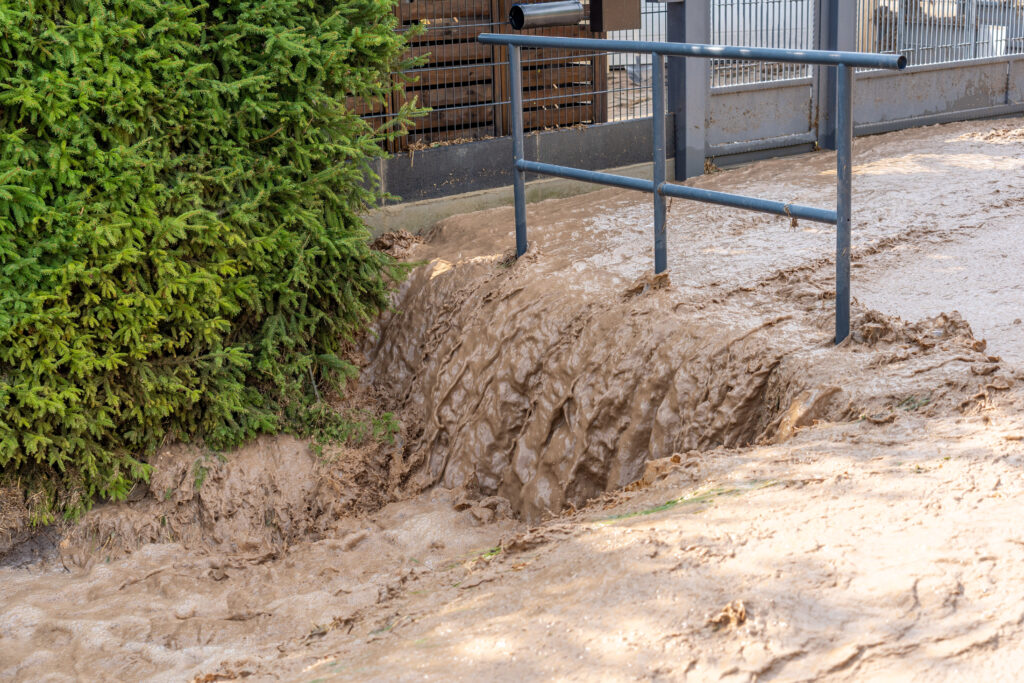
Intense rainfall can trigger dangerous muddy floods within minutes. To investigate this further, Friedrich-Alexander-Universität Erlangen-Nürnberg (FAU) is participating in a European research project called MUDCAP (MUDdy flood mitigation through transnational action-oriented CAPacity building). In conjunction with research institutions, municipal authorities and water management agencies from Belgium, France and Germany, the project partners are developing strategies to improve our ability to predict the risks of such events, reduce damage and to make the regions affected more resilient to them. The focus of FAU’s sub-project lies on how local authorities and other stakeholders can work together more effectively. The project is being funded by the European Union in the Interreg North-West Europe program and will run from 2026 to 2029.
“Protection against flooding can only be effectively implemented if local governments coordinate well with one another.”PD Dr. Klaus Geiselhart
When heavy rain becomes a muddy flood
Muddy floods are caused by intense rainfall washing away large amounts soil and transporting it down into the valley below. Streets, houses, agricultural land and bodies of water can suffer considerable damage in a very short time because of them. Regions with loess soil that is prone to erosion as found in large parts of north-west Europe are particularly badly affected. The increase in extreme rainfall events due to climate change means that the risk of such events is also increasing.
“Flood protection measures can only be implemented effectively if local authorities work well together,” explains PD Klaus Geiselhart from the Institute of Geography at FAU. “One challenge is to bring together stakeholders from research, administration, politics, agriculture and the general population so that joint decisions can be made. Our project aims to develop suitable formats for this.”
Collaboration instead of isolated solutions
Many effective measures against soil erosion and surface runoff are already well known. However, in practice, they are often only implemented at a local level or are very difficult to transfer to other regions. This is where MUDCAP comes in: The project combines scientific knowledge, practical experience and local knowledge to develop solutions that can be used in different regions in north-west Europe.
Components for better precautions
MUDCAP has three objectives: The project partners are developing improved methods for recording and documenting muddy floods as well as digital tools such as databases, risk maps and decision-making tools for municipal authorities.
- The project partners are developing improved methods for detecting and documenting mudslides, as well as digital tools such as databases, risk maps, and decision-making aids for local governments.
- In model regions, the partners are working together to test new forms of collaboration between municipal authorities, water management agencies, agriculture and the general public and develop specific measures for mitigating risk.
- The results will be made available to other regions through training sessions, guidelines, and open-access materials.
FAU is contributing its expertise at the interface between environmental and social sciences and in transformation research. The team led by Klaus Geiselhart is investigating how municipal authorities can overcome administrative boundaries and plan flood prevention measures together. The aim is to set up structures across departments and districts that will remain in place after the project has been completed.
Knowledge for all of north-west Europe
The approaches are being tested in four model regions in Belgium, France and Germany. The model region in Germany is in the catchment basin of the Kundelbach in the Trier-Saarburg district, where researchers are collaborating with the municipal authorities, water management agency, agriculture and other local stakeholders to transfer findings from research into solutions that can be put into practice in municipal flood prevention.
MUDCAP brings together universities, research institutes and authorities from Belgium, France and Germany. Together, they hope to ensure that regions in north-west Europe are better prepared for muddy floods and that successful strategies can be adopted across national borders in the long term.
Contact
PD Dr. Klaus Geiselhart
Institute of Geography