
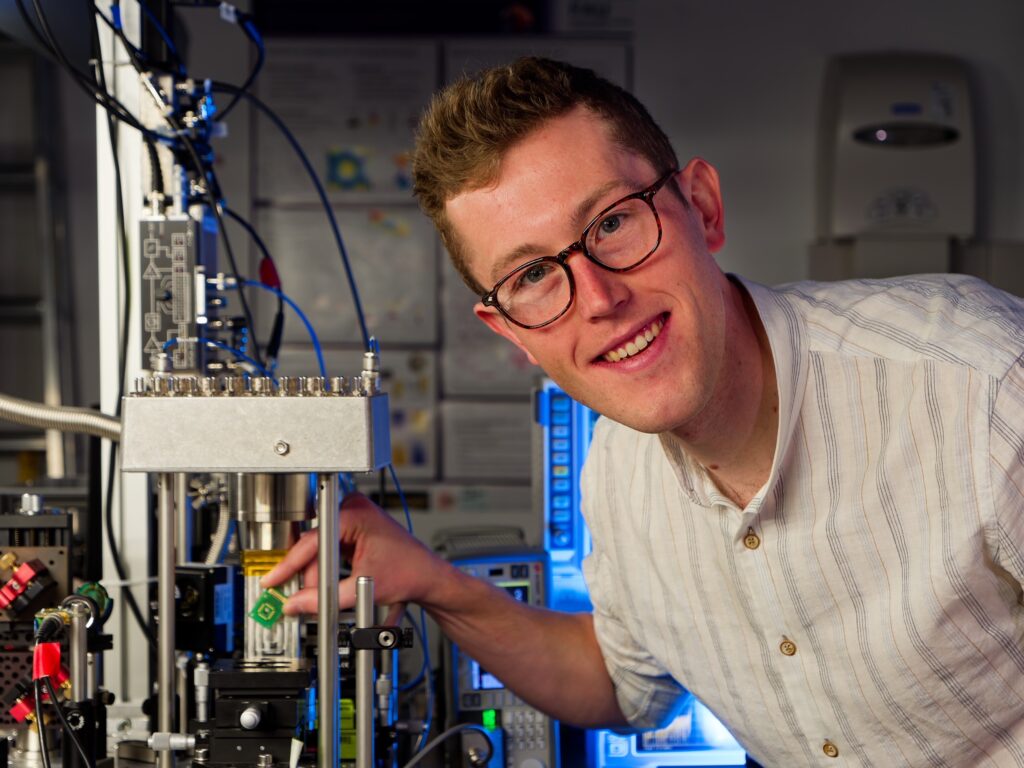
Physicists at FAU create a conducting material with exotic properties using light irradiation
Topological insulators are materials with very interesting electrical properties. However, they are very difficult to produce. Researchers at Friedrich-Alexander-Universität Erlangen-Nürnberg (FAU) have now succeeded in teaching a material that is easy to produce to behave like a topological insulator. In addition, they were able to manipulate the movements of the electrons in the material as required. Their work could become the basis for a new type of extremely powerful computer. Their work has now been published in the journal ‘Nature Physics’*.
For a long time, the world was quite simple for solid-state physicists: There were materials that conduct electricity (conductors, for example most metals) and there were others that don’t (insulators) and then others who required a little “push” before they could be persuaded (semi-conductors).
In 2007, they were joined by a fourth group of materials: Topological insulators. These materials only conduct electricity on their surfaces and do so extremely well. They remain insulators in their core. This phenomenon is extremely interesting for physics for several reasons. However, it is not easy to produce topological insulators, which means only a handful of these exotic compounds exist.
Researchers at the Chair of Laser Physics at FAU have now successfully managed to give graphene the properties of a topological insulator. Graphene is a material made up of one single layer of carbon atoms. These are arranged in a hexagonal pattern such as the honeycombs in a beehive.
Polarized light forces electrons onto a circular path
Graphene is relatively easy to produce. It usually doesn’t have any unusual electrical properties – it simply behaves like a conductor. “We irradiated graphene with intense, very short laser pulses”, explains Dr. Daniel Lesko, a postdoctoral researcher at the Chair of Laser Physics. “The graphene took on the properties of a topological insulator for as long as these pulses lasted.” In physics, this phenomenon is known as a Floquet state.
The reason for this is that band gaps are created by the laser pulses, which are like “no-go areas” for electrons that limit the movement of the load carriers. As a result, the electrons can only remain in narrow bands and cannot easily move between them.
“Our laser beam had a property that we call “circular polarization”, says Lesko. In this process, the electromagnetic light field constantly changes direction – similar to a hose that you swing in a circular motion while watering flowers. “This means the electrons in the graphene were forced onto a circular path, similar to when ice skaters all move in the same direction on an ice rink”, explains Lesko.
Beam me up, Scotty!
The researchers then irradiated the material with a second laser beam that had exactly double the frequency of the first beam. The photons of this laser therefore also had double the energy. This meant the physicists were able to “beam” the electrons onto another circular track. Or to put it more precisely, only some of the electrons. It is as if the ice skaters pass through a spotlight on a certain point of the ice rink and are beamed away.
On the new “ice rink”, the electrons that had been beamed away now traced a curved path, depending on which point of the circular track the spotlight had caught them. “We were able to vary the location of the spotlight and therefore this Berry curvature as we liked and could do so extremely quickly”, says holder of the Chair Peter Hommelhoff, who has since moved to LMU Munich. “In theory, this property could be used for particularly fast and powerful computers.”
A second effect the scientists observed could also make a contribution to this. Even though the electrons on the original circular track move in the same direction and have the same energy, they are not identical. It is as if some of them are wearing blue t-shirts while others are wearing red t-shirts. The physicists were able to set their spotlight in such a way that it only beamed up the “ice skaters” in red, for example. In principle, computer components could use this to process twice the amount of information, depending on whether they are using the “red team” or the “blue team” for their calculations.
The theoretical basis for this work comes from the working group led by Prof. Ofer Neufeld at the Israel Institute of Technology in Haifa. The publication is therefore also the result of successful international cooperation.
*DOI: https://doi.org/10.1038/s41567-026-03429-7
Further information:
Website of the Chair of Laser Physics: https://www.laserphysik.nat.fau.de/
More about materials research at FAU: https://www.fau.de/category/materialforschung/
Contact
Dr. Daniel Lesko
Chair of Laser Physics
daniel.lesko@fau.de
Prof. Dr. Peter Hommelhoff
Chair of Laser Physics
peter.hommelhoff@fau.de