
Geographers at FAU involved in international study – a lack of data hampers reliable prediction of rising global sea levels
The ice mass in the Antarctic is an important indicator for rising sea levels triggered by climate change. In spite of numerous research projects and permanent satellite observation, however, there is a lack of data required to accurately predict ice loss. This is the conclusion reached by an international study involving geographers from Friedrich-Alexander-Universität Erlangen-Nürnberg (FAU). Especially the properties of the bedrock along the approximately 20,000 kilometer long coastline of the Antarctic are largely unexplored, and yet this would be crucial for the interpretation and modeling of complex ice movements. The results of the study have been published in the journal “Reviews of Geophysics”.
Roughly 90 percent of the entire ice in the world is saved in the Antarctic. If large quantities of these ice sheets were to melt, it would lead to a dramatic rise in global sea levels. “Thanks to satellite observations, we now have good data on ice movements and surface changes,” explains Dr. Thorsten Seehaus from the Institute of Geography at FAU. “However, we are lacking information on ice thickness and the bed topography along the coasts and underneath the ice shelves that cannot be observed from space.”
“The Antarctic coastline is a closely interconnected system where ice lying on the ocean floor meets the ocean and in which small changes can make a huge impact.”Dr. Thorsten Seehaus
Interconnected system of ice, ocean and ocean floor
In a recent study, 80 researchers from 16 countries have summarized the current findings on the interactions between ice, ocean, atmosphere and the subsurface in the Antarctic coastal zone. The researchers from the areas of glaciology, oceanography, geophysics and atmospheric sciences have identified major gaps in knowledge, particularly regarding bed topography. These blind spots mean that even highly developed models of the ice sheet can deliver inaccurate results. For instance, when assessing ice movements, it is crucial to know whether the subsurface rises or falls on the approach to the sea. The study has been coordinated by the RINGS group of the Scientific Committee on Antarctic Research (SCAR).
“Ice loss in the Antarctic is caused predominantly by the interaction between the ice and the surrounding ocean and by ice discharge at the edges of the ice sheet, and less by ice melting on the surface,” explains Seehaus. “The Antarctic coastline is a closely interconnected system where ice lying on the ocean floor meets the ocean and in which small changes can make a huge impact.” Processes close to this grounding zone, the point at which the ice rises from the ocean floor and starts to float, may trigger counter reactions that accelerate ice loss.
Coordinated action necessary
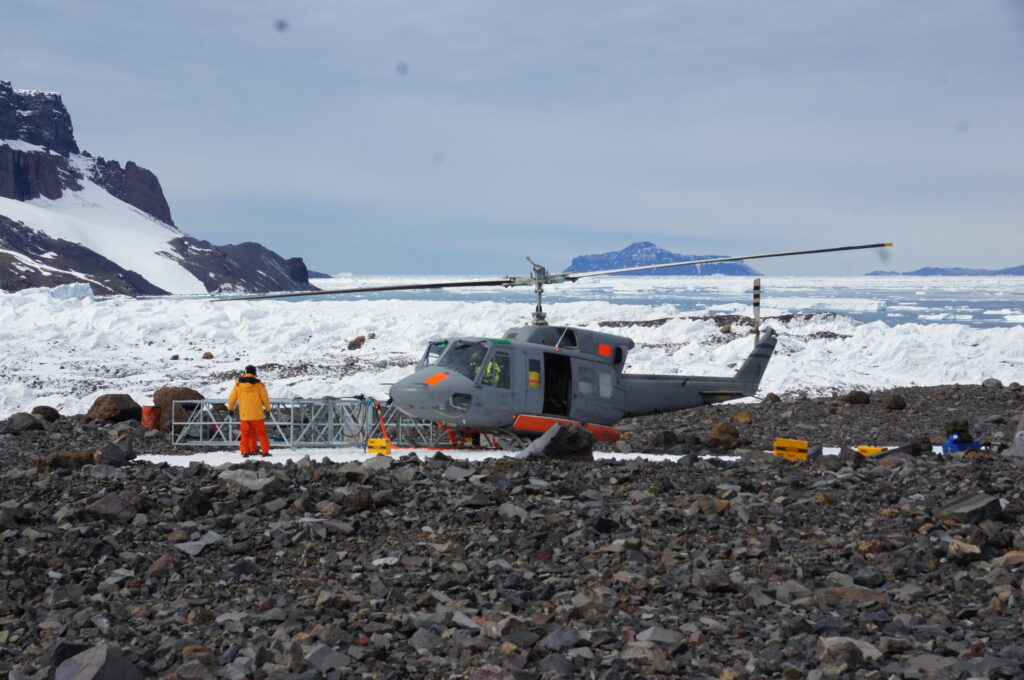
In recent years, geographers from FAU have been involved in several expeditions to the Antarctic peninsula, a region in the northwest of the continent. Together with the the Alfred Wegener Institute Bremerhaven and research partners from Argentina, they have measured the thickness of the ice sheet there from airplanes and helicopters. Future projects, including with partners from South America, are in the pipeline and aim to close gaps in the knowledge concerning ice thickness and the topography of coastal regions. According to Thorsten Seehaus, “cooperations like this are important, as no one country has the resources to provide comprehensive data for the whole region.” Furthermore, as stated explicitly in the study, central coordination of the international research projects is essential to avoid data gaps and duplicate data collection, and to create an evidence-based framework for improved projections of sea levels.
* DOI: https://doi.org/10.1029/2022RG000803
Further information:
FAU researchers in Patagonia: Surveying icy landscapes
FAU research on glacial melting: Climate change Glaciers melting at an alarming rate
FAU research on climate change: Energy and climate
Contact
Dr. Thorsten Seehaus
Institute of Geography