
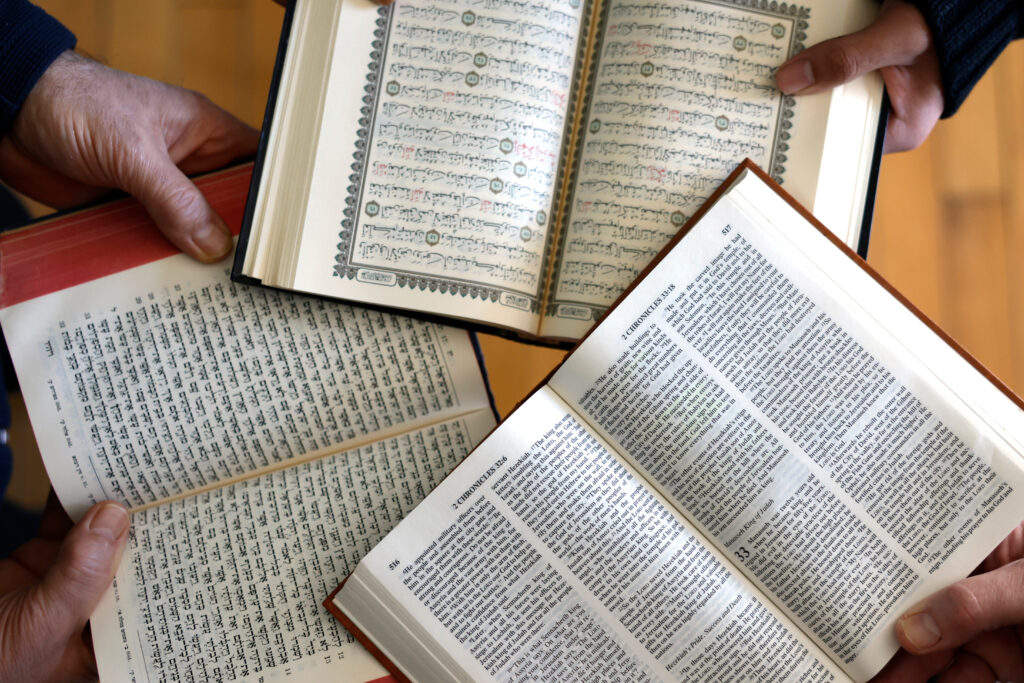
New model project “Religions for Democracy” aims to put Judaism, Christianity and Islam onto the agenda.
Does democracy need religion – and does religion need democracy? What do dignity, solidarity or responsibility have to do with faith? A new model project at Friedrich-Alexander-Universität Erlangen-Nürnberg (FAU) is looking for answers from the Jewish, Christian and Islamic perspectives. The project does not only address researchers, however: Secondary school students will also have the opportunity to have their say.
Trust cannot be prescribed. And neither can solidarity. A state cannot pass a law to demand confidence and a sense of responsibility. And yet all these aspects are important for living together in a democracy. What role can religions play in this respect? And when might they actually become a danger for democratic societies? These are the questions at the center of the model project “Religions for Democracy” launched this summer at the Bavarian Research Center for Interreligious Discourse (BaFID) at FAU.
Does democracy need religion, and does religion need democracy?
The project is being funded by the Federal Agency for Civic Education (Bundeszentrale für politische Bildung, bpb) Until the end of 2027, the project will investigate the potential Judaism, Christianity and Islam have to encourage and support democracy, and what marks the tipping point when they may become a danger to democracy. The aim is to design and provide educational teaching materials for schools.
“A democracy does not depend on religion to function,” explains project coordinator Viviane Arbeiter. “However, religion can contribute something to the principles of living together in society that cannot simply be instigated through laws: Trust, confidence, solidarity or a sense of responsibility.”
Where do religion and democracy meet?
The project is tackling a total of nine topics. The first question is “Does democracy need religion?”. Judaism, Christianity and Islam are not being examined in isolation, but rather being considered in relation to each other and to secular thinking. It is this sustained discourse between the three major monotheistic religions that sets the project apart.
All three traditions have aspects of relevance to democracy: In Islam, for instance, the schura principle places considerable value on consultation. In Christianity, there is a focus on human dignity. And the Jewish philosopher Moses Mendelssohn focused in the 18th century already on separating the powers of state and religion.
What else do we know about religion?
“Religions for Democracy” does not only intend to investigate common features and religious traditions that encourage democracy. “We are also interested in discovering the tipping point,” Arbeiter explains. The researchers hope to strengthen “religious literacy”, that is the well-founded ability to critically assess religions, their various traditions, and their significance to society.
The researchers from BaFID repeatedly encountered a lack of understanding both in presentations and discussions, and during conversations with teachers. Again and again, they encountered misunderstandings and a lack of knowledge about other religions. “We want to make knowledge accessible at the same time as demonstrating that neither Judaism nor Christianity nor Islam speak with just one voice. You have to be aware of these differences if you want to discuss the role of religion in a democracy,” Arbeiter says.
From research to the classroom
The project led by BaFID director Prof. Dr. Georges Tamer is therefore not only aimed at other researchers. Instead, the project aims to adapt the research findings for teaching purposes and develop teaching materials. The team is working with teachers from across Germany. Secondary school students from various types of schools in Germany will be involved in the development and testing of the materials. The first partner school is the Ohm Gymnasium in Erlangen.
Young people involved in the project will be able to give their feedback on the developed materials through their teachers. “If we are to develop materials for school students, we have to know whether our topics and the language we use actually hit the mark,” says Arbeiter. “We can only provide effective teaching materials if we integrate feedback gained through practical trials.”
Short videos to prompt discussion
One important component will be nine short videos of between three and five minutes in length based on scientific findings. They do not intend to provide final answers, but rather to offer an introduction to the topic: Adolescents will watch a video and then discuss the questions raised with their teachers. Background texts and teaching materials are also provided in addition to the films.
In this way, “Religions for Democracy” combines research into religion with civic education. Religious diversity is not viewed in the first instance as a field of conflict, but rather as a possible resource for a democratic society. A knowledge of religious positions and an ability to contextualize and discuss differences makes individuals less susceptible to oversimplification and othering. The project aims to strengthen democratic competences and demonstrate what Judaism, Christianity and Islam can contribute to life in society based on freedom, solidarity and responsibility.
The Bavarian Research Center for Interreligious Discourse (BaFID) at Friedrich-Alexander-Universität Erlangen-Nürnberg (FAU) is conducting research into the relations between Judaism, Christianity and Islam. The Center is funded by the Bavarian State Ministry of the Interior, Sport and Integration. The lead investigator of “Religions for Democracy” is BaFID director Prof. Dr. Georges Tamer.
Contact
Viviane Arbeiter (M.A.)
Chair of Oriental Philology and Islamic Studies