
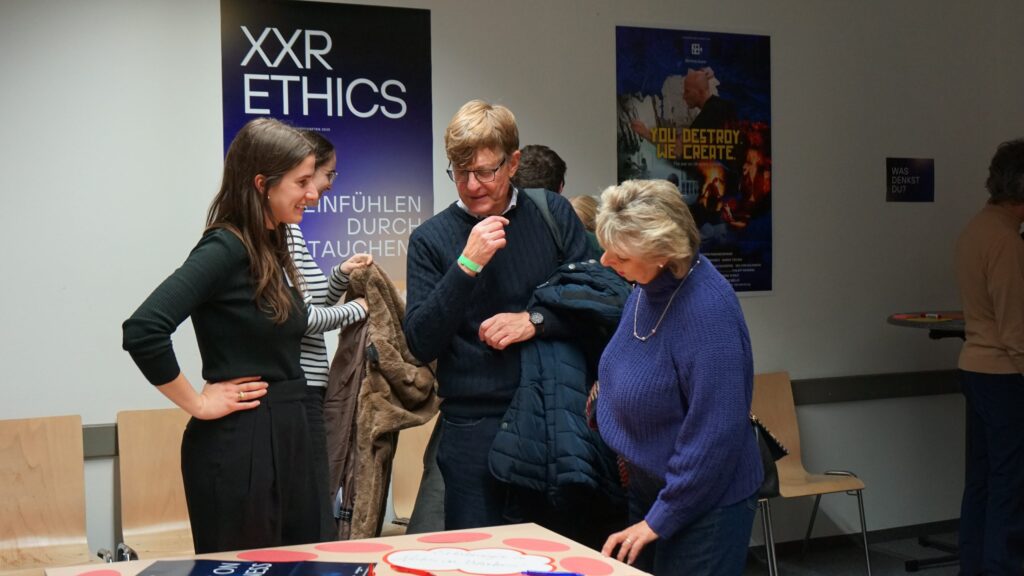
Madlen Geidel and Dr. Max Tretter discuss ethical responsibility in journalism in immersive media with students
Putting on a VR headset, immersing yourself in a digital world and then having a discussion about it: For their seminar called “Experimental Expanded Reality Ethics”, Madlen Geidel Chair of Media Communication, Media Ethics and Digital Theology and Dr. Max Tretter, Chair of Systematic Theology II (Ethics), have received the Teaching Award for Innovative Teaching Concepts from the Faculty of Humanities, Social Sciences, and Theology at Friedrich-Alexander-Universität Erlangen-Nürnberg (FAU). The topics discussed with students during the seminar included empathy, racism, and ethical responsibility in journalism in VR applications.
Virtual reality (VR) applications were the focus of the seminar. VR creates digital experiences during which people put on special headsets and explore a virtual world. VR applications are an immersive technology. “Immersive” (from the Latin for “to plunge”) describes the spatial and emotional immersion in an experience.
Since immersive technologies are gaining in importance in society, Geidel and Tretter decided to investigate the ethical issues this raises with their students. “When students use a VR application themselves, they experience the subject of our research instead of just reading about it,” explains Geidel. “This is the reason why we provided participants with VR games and films that feature topics that are highly topical in our society.”
Virtual reality worlds: Between empathy and acquisition
The students tried the various applications, recorded their thoughts and discussed them with the support of academic literature. For example, in “Notes on Blindness” a virtual abstract environment shows the experiences of the author John Hull who became blind. The short VR film “You Destroy. We Create.” was also used. It shows how people in Ukraine are protecting art and culture during the war. “This enabled us to discuss empathy, acquisition and ethical responsibility in journalism in these VR games based on students’ own experiences”, says Tretter.
The reactions to these VR programs differed greatly. For example, some participants preferred realistic portrayals while others thought abstract approaches were more appropriate. Tretter remembers to what extent previous personal experiences can shape your perception: “With simulations in particular, the question was raised as to whether they simplify the realities of life of other people. This is because during a virtual experience, you can take the headset off at any time. This point of view in particular helped the group to not only assess experiences in the first person, but to consider the ethical questions they raise.”
Ethics Lab: Students shape their own learning process
Participants were given a great deal of freedom to perform research independently and plan their work. Geidel and Tretter provided support in the form of regular feedback meetings. “What pleased us most was how much personal motivation the students had. We trusted that they would deliver – and that’s what they did.”
Geidel and Tretter want to build on this concept with the planned “Ethics Lab”, where students find their own topics and explore ethical questions. Virtual reality and extended reality, which are technologies that integrate digital elements in real environments, could play a role once more.
Honoring an innovative teaching concept
Geidel and Tretter were presented the Teaching Award for Innovative Teaching Concepts from the Faculty of Humanities, Social Sciences, and Theology for their VR seminar. In addition to a trophy, they received prize money of 2000 euros. The Faculty’s teaching award has been presented since 2020. The Deans of Studies of the Faculty decide who will be awarded the prize after all applications have been received.
Contact
Madlen Geidel
Chair of Media Communication, Media Ethics and Digital Theology
Contact
Dr. Max Tretter
Chair of Systematic Theology II (Ethics)