
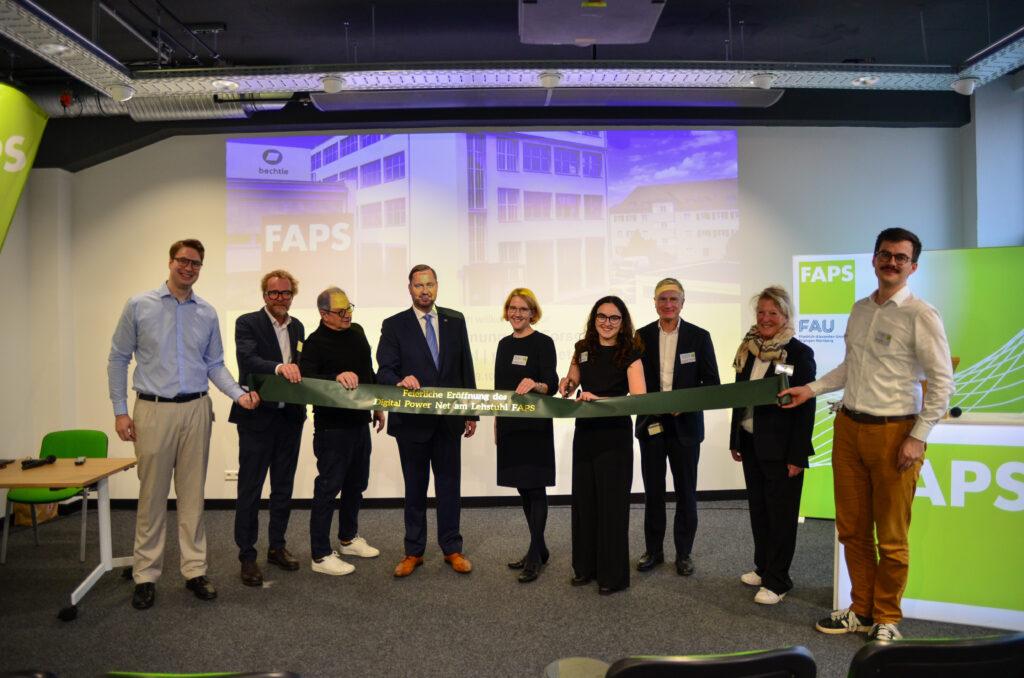
New FAU research center opened in Nuremberg
What may be a matter of course for an experienced technician can prove to be challenging for a machine. For instance wiring a switch cabinet or producing a wiring harness for a car. The research area Signal and Power Networking (SLV) at the Chair of Manufacturing Automation and Production Systems (FAPS) at Friedrich‑Alexander-Universität Erlangen‑Nürnberg (FAU) investigates new technologies to advance automation for these industries. The new research center digital | power | net has been established for this purpose, and was opened on October 9.
A cable is not always where it is supposed to be according to the design plan. When it is grasped, it changes position. For humans, that is not a problem: they are able to recognize cables, grasp them, guide them, connect them – and finally check that everything is correct. For a robot, each of these steps is a challenge. In Nuremberg, in the new Hall 14 “Auf AEG,” researchers from FAPS are now developing technologies for production in which not every product is identical. Numerous guests from research, industry, politics and the media were present at the ceremonial opening on Muggenhofer Straße to see the new FAPS site and the new research center.

Assistance rather than rigid automation
While automation has long been established in industrial mass production, the situation is different for individualized products. Switch cabinets are often manufactured in small batches or even as single units. Vehicle wiring harnesses also differ depending on the model and equipment. The central question therefore is: How must robots and digital systems be equipped to deal with these challenges?
One approach is to use existing digital design data directly for manufacturing. In a laser‑based worker assistance system for switch cabinet assembly, for example, assembly and wiring information is displayed directly on the assembly plate. This gives the technician exactly the information they need for the next step. The system can not only support experienced staff but also enable less experienced workers to perform the task reliably. “This could make automation particularly attractive where companies, faced with a shortage of skilled workers, are looking for new approaches,” explains Oliver Stelter, research associate at FAPS.
In contrast, the project “Robotic Automation for Modular Systems in Electrical Switchgear Production” (RAMSES) places the robot itself at the center. In cooperation with the company Rittal, FAPS is developing a modular robot platform that can be configured for different assembly tasks. The goal is automation that does not have to be completely reprogrammed for each product, using modular software and modular hardware. But as much as possible should also be automated at the end of a production process: The subproject “Precision robotics for testing large electrical appliances” (ProTekt) is working together with partners to develop a flexible testing solution for individual switch cabinets: The intention is for cameras, robots and project data to work together in this process.
When cables change shape
It becomes even more difficult with vehicle wiring harnesses. When they are grasped and moved, the flexible cables change position. The SLV research area is therefore examining the entire production chain –from detection and grasping, through guiding and plugging, to bundling and testing the cables.
The subproject Next2OEM demonstrated what such automated production could look like. Together with Audi and other partners, the manufacture, testing and assembly of a center‑console wiring harness were digitized and automated. A central question was whether, and under what conditions, wiring harness production could be located closer to the vehicle manufacturer in the future.
Another research approach concerns the sheathing of cable bundles. “Instead of fixing and protecting them manually with cable‑ties as before, we have developed a process that bundles and protects the cables with a sprayed liquid encapsulating material and applies it fully automatically,” explains Oliver Stelter. The technology is now being developed further in a follow‑up project together with TE Connectivity.
From Nuremberg to industry
Supply chains also play a role. The project ARKIDES therefore focuses on the automated disassembly of electrical equipment. Artificial intelligence is intended to identify components in switch cabinets and assist robots during disassembly. This makes it possible to recover existing components and materials for further use.
“The importance of research at FAPS goes beyond individual demonstrators. Flexible automation solutions could open up new opportunities, especially for small and medium‑sized enterprises,” says Prof. Dr. Jörg Franke, holder of the FAPS chair. “If machines can handle small batch sizes and changing products, production processes can be adapted more closely to individual requirements.”
The former AEG site in Nuremberg provides a special location for these developments. FAU, Energie Campus Nürnberg and the OHM Innovation Center are located close to one another. This proximity enables researchers, companies and startup teams to collaborate directly. The vision is production that no longer needs to distinguish between “automatable” and “non‑automatable,” but instead adapts flexibly to new products and tasks. “With the automation solutions advanced at digital | power | net, value‑adding activities lost to low‑wage countries in wiring‑harness production can be brought back to Germany,” says Jörg Franke.
Contact
Prof. Dr.-Ing. Jörg Franke
Chair of Factory Automation and Production Systems