
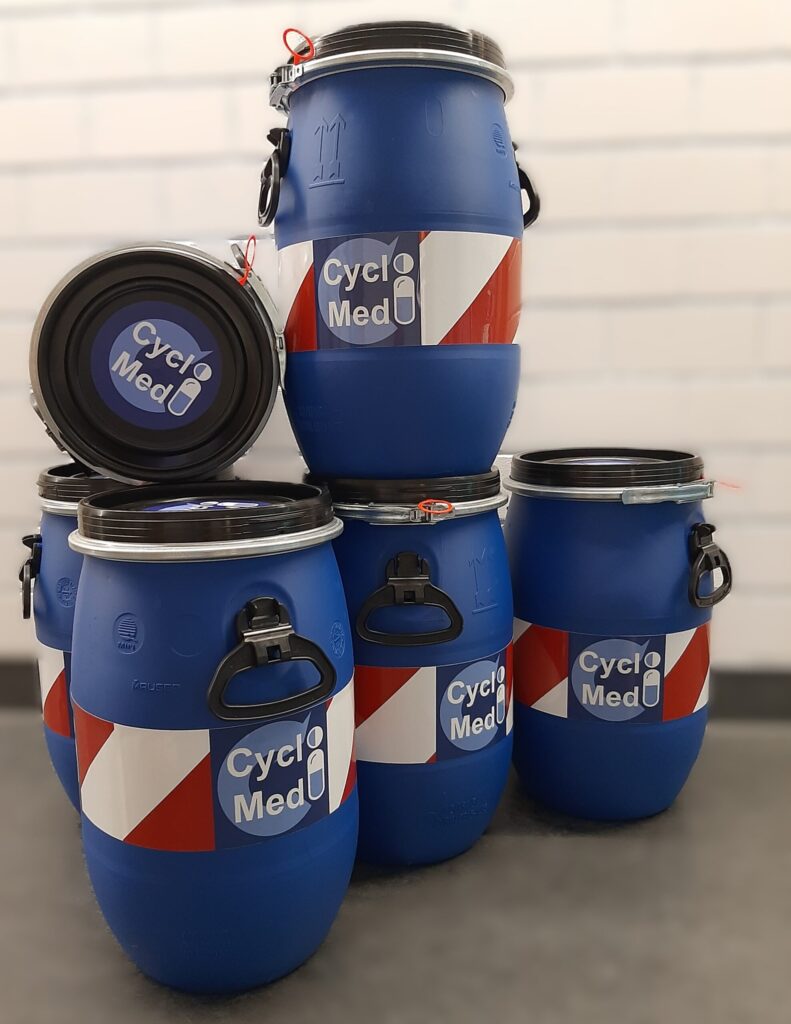
FAU launches a pilot project for innovative collecting system in Erlangen
People often simply throw out medicine they no longer need. And yet it is a huge potential source of active ingredients that can be both expensive and rare. Bearing this in mind, the team led by Prof. Dr. Markus Heinrich from Pharmaceutical Chemistry at Friedrich-Alexander-Universität Erlangen-Nürnberg (FAU) has now launched a pilot project in Erlangen, aimed at collecting unused medicines containing specific active ingredients. The long-term goal of CycliMedi is to work in collaboration with industrial partners and recover active ingredients from unused medicines to produce new medicines.
Pilot phase launched in Erlangen
Ten pharmacies across Erlangen are now accepting unused medicines for the CycliMedi program. An interactive map on the CycliMedi website shows which these are. You can also read about which medicines are currently being collected. The page works well using a smartphone and a scan function helps to search for hidden treasure in your own medicine cabinet. “Ideally, the citizens of Erlangen should only bring the listed medicines to the pharmacies taking part in the project,” explains Professor Heinrich.
In Erlangen, medicines that are currently not being collected can be disposed of together with normal household waste. Dangerous medicines, for example those containing cytostatic drugs such as cancer medication, should be handed in to the recycling depot at Erlangen harbor.
Valuable active ingredients, not waste
Markus Heinrich and his team have already been collecting unused medicines for recycling for ten years now, working together with a number of different partners including pharmacies in Erlangen, hospital pharmacies throughout Germany, and the waste management association in Luxembourg. The working group uses the unused medicines to continue improving the procedure for recovering active ingredients. The materials that are processed in this way are then used in research and teaching at FAU. “In Pharmacy, we often require active ingredients that can be extremely expensive if we have to purchase them from chemical wholesalers,” Markus Heinrich explains. As the amount of active ingredients available is steadily rising, the working group has already been able to support a number of other universities across Germany, and have done so for several years now. The first European partners joined the initiative last year.
Although the initial goal was to help research and teaching, the initiative may soon take the next step: “We are getting better and better at recovering the active ingredients in very high degrees of purity,” says Markus Heinrich. This opens the door to another prospective use in addition to research: “We are working to scale up the recovery of active ingredients to allow the procedure to be used on an industrial scale to make new medicines in future. And the new CycliMedi collection system is an important component.”
“Until now, we have accepted a wide range of different medicines in all sorts of dosage forms. Now we want to focus on certain active ingredients. For instance, one of the areas we intend focusing on is antibiotics, as many of them are currently subject to supply bottlenecks,” says Markus Heinrich. The specific medicines that are currently in demand are listed on the website www.cyclimedi.de.
Hidden treasures in your medicine cabinet
The FAU researchers are pursuing two aims with CycliMedi: They are testing a system for collecting specific active ingredients sorted according to type. And they are investigating whether a raw-material flow that has been largely neglected to date could be incorporated into pharmaceutical production. It is still unclear how efficient the process is. Are the correct medicines being handed in? How easy is it for people to use the new collection system? And is this approach really suitable for collecting sufficient quantities for it to make sense to recover active ingredients in this way, both from an economic and an ecological point of view?
The research group is concerned about more than recycling. One important concern they have is to make the supply of critical pharmaceuticals in Europe more robust in the long term. “Nowadays, many active ingredients are no longer produced in Europe, and supplies of them therefore often depend on fragile global supply chains. If we succeed in recycling active ingredients, the hope is that we could at least use already existing resources to a certain extent,” explains Markus Heinrich. The source material is already available and recovery tends to be considerably more straightforward than the elaborate production process using basic chemicals. It is estimated that up to 50 percent of medicine currently on the market could remain unused.
The research on optimizing the recovery process for active ingredients is being funded by the STEP-EFRE program (Strategic Technologies for Europe, co-financed by the European Union).
Contact
Prof. Dr. Markus Heinrich
Professorship for Medicinal Chemistry