
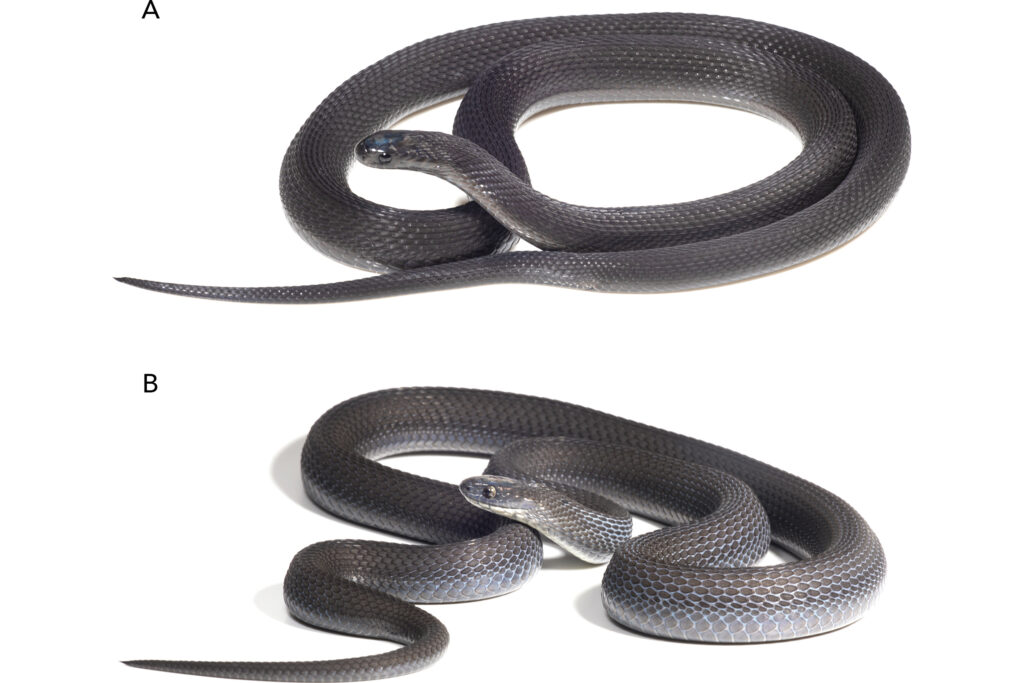
FAU researcher Arthur Tiutenko is carrying out research into several previously unknown species of snake
While the world economy is more concerned by the fact that the maritime chokepoint of the Bab al-Mandab Strait between the Horn of Africa and the Southwest regions of the Arabian peninsula is often the target of Huthi rebel attacks, for a researcher from Friedrich-Alexander-Universität Erlangen-Nürnberg (FAU), the Horn of Africa is the location for his research into several previously unknown species of snake. Just recently, Dr. Arthur Tiutenko, working together with colleagues from LMU München and the South African National Museum in Bloemfontein in the Harenna Forest at the southern slopes of the Ethiopian Bale Mountains, discovered a new species of snake, the Dasypeltis albigularis or white-throated egg-eater. “Three other new species in this genus are still waiting in line,” the zoologist adds.
The discovery of these new species of reptile began when a local employee brought a young female specimen to the team of researchers in the Harenna Forest. At first, Arthur Tiutenko thought it was a Dasypeltis atra, or montane egg-eater. Several egg-eating snakes living in Ethiopia were previously classified as belonging to this species, which is common in the eastern Congo Basin, although none of them had previously been found in the Harenna Forest. The forest covers several thousand square meters of mountainous territory in the south of Ethiopia and falls steeply down from peaks reaching up to 4,000 meters above sea level to the dry Savannah plains at approximately 1,000 meters above sea level. This huge forest, that is almost the size of the Middle Franconian region, is home to plants which are now cultivated across the globe in tropical highlands for their beans, which are roasted and sold as Arabica coffee.
An exclusive diet of eggs
This region that is considered the birthplace of coffee is still largely considered a blank spot on the map when it comes to science. That is exactly what Arthur Tiutenko is now changing. His chosen research subject of egg-eating snakes is a group of animals with a truly spectacular way of life. While other snakes may eat eggs occasionally, they are the sole diet of egg-eating snakes. Through evolution, the animals have adapted to this exclusive diet with extended vertebrae reaching into their esophagus. As soon as an egg reaches them, muscles contract and the bones slice the egg shell open like a miniature saw. Further muscle contractions press the contents towards the stomach and intestines, with the peeled egg shells being dispelled through the mouth.
This method is already mastered by the freshly hatched white-throated egg-eaters, which only weigh one and half grams, are 20 centimeters in length and have a body the thickness of a knitting needle. The only staple food source that comes into question for these tiny babies are the tiny eggs from small bird species. Africa is home to an unusually wide variety of such bird species. “That may also be the reason why egg-eating snakes only live in Africa, and in particular in a small area in the southwest corner of the Arabian peninsula,” Arther Tiutenko hypothesizes.
Mating behavior gave an important clue
The zoologists from FAU had already noticed marked differences between the snake from the Harenna Forest and the previously known montane egg-eater: Instead of being entirely black, the snake from Ethiopia has a white patch extending over its throat and down over approximately the first 60 scales on its stomach, and the skin that shimmers through between the scales is blue in color. In addition, other egg-eating snakes rub their scales together to generate a loud sound they use to scare off possible enemies. The white-throated female makes the same movement, but without making a sound.
One important clue was given when this animal mated with a male montane egg-eater: While normally all offspring would hatch in a normal clutch of eggs, when these animals crossbred, only one single female hatched from a total of 21 eggs. This very low quota is not the only indication that they are indeed two separate breeds. A further indication came from surprising behavior on the part of the male: He no longer chose to mate with the female from the Harenna Forest, and only appeared attracted to animals of his own species or his own daughter, a hybrid that was at least partly the same species. The FAU researcher’s suspicion was finally confirmed by examining the genetic material: The black snake with the white throat from the Harenna Forest is obviously a separate, previously undiscovered species. And there’s more: Arthur Tiutenko is currently conducting research into three different egg-eating snakes from the Horn of Africa, one black, one red and one patterned.
Further information:
A new species of ‘black’ egg-eating snake of the genus Dasypeltis Wagler (Squamata, Colubridae, Colubrinae, Boigini), in: