
Start-up aims to make quantum processors suitable for industrial applications
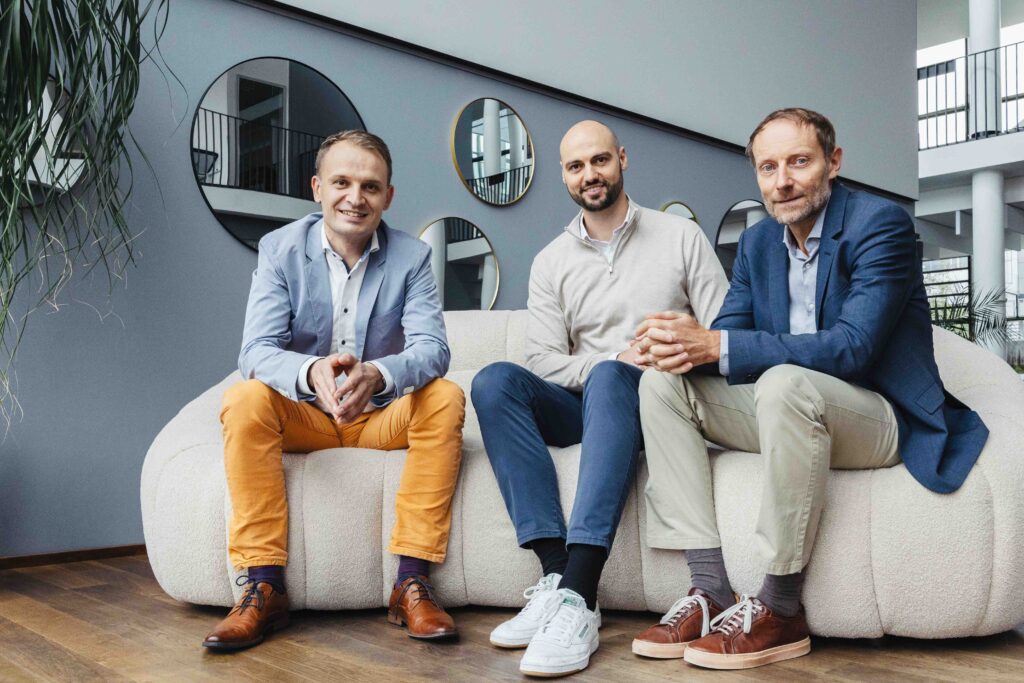
It is the largest amount of seed funding raised by a quantum computer company in Germany to date: Quint Computing GmbH, a start-up set up by researchers from Friedrich-Alexander-Universität Erlangen-Nürnberg (FAU) has received 9.1 million euros from a venture capital consortium. The start-up develops quantum processors with a new type of hardware architecture that drastically reduces the outlay for correcting errors and that should prepare quantum computers for industrial applications. Quint was set up in 2025 by FAU quantum physicists Prof. Dr. Christopher Eichler and Prof. Dr. Michael Hartmann and tech economist Dr. Jona Stinner.
The enormous power of quantum computers has been demonstrated several times during the last few years. However, quantum processors, also known as qubits, are extremely fragile: Above all, external influences such as thermal noise or imprecise control pulses can interrupt the quantum properties or cancel them out altogether. “Correcting errors is essential for reliable quantum computing, but extremely complex compared with conventional computers,” says Prof. Dr. Christopher Eichler, who has been Chair of Experimental Physics since 2022.
Detecting errors at source
Up to this point, it has not been possible to directly pinpoint malfunctioning processors but only locate them in a certain area of the quantum chip. Many quantum computer developers are therefore working on increasingly larger platforms with more and more qubits since a large number of qubits is required to correct errors. “I am skeptical about this strategy”, explains Eichler. “We should scale up the technology to get more computing power and not primarily to correct errors.”
Christopher Eichler is therefore developing a hardware architecture that detects errors directly at the source. His idea: Designing qubits so that they integrate computing and control functions.. “If this is successful, for most of the detected errors, only the affected qubit will need to be reinitialized,” he explains. “This would save thousands of correction loops and facilitate considerably higher computing power with quantum processors of a comparable size.”

“Quint supplies the quantum processors and builds the systems so that FAU can concentrate on the fundamental research questions.”Prof. Dr. Michael Hartmann
Quantum computers for industrial applications
“Last year, to make the new quantum hardware suitable for a wide range of industrial applications, Eichler founded Quint Computing GmbH together with Prof. Dr. Michael Hartmann from the Chair of Theoretical Physics at FAU and tech economist Dr. Jona Stinner. The company now employs ten people “Quint supplies the quantum processors and builds the systems so that FAU can concentrate on the fundamental research questions,” says Hartmann, who is a former member of the Sycamore Project with which Google first demonstrated the superiority of quantum computers.
Quantum computing possesses huge potential for a large number of applications that need high amounts of computing power: In chemistry and pharmaceutical research it could facilitate computer-aided modeling that is not feasible with conventional methods. This could rapidly accelerate the development of drugs, for example. In industrial manufacturing, quantum computers could take on complex planning and optimization tasks, with the goal of minimizing production times and using resources more efficiently. According to estimates, the economic benefits of quantum computing in these sectors alone amount to hundreds of billions of euros. “Quint investigates such application scenarios to tailor quantum processors to future customer requirements and exploit potential”, explains Michael Hartmann.
Embedded in a strong environment
Venture capital of 9.1 million euros is the largest amount to date that has been made available to a German quantum computer company as seed financing. The investors include notable international venture capital companies such as VSquared, Quantonation, Nucleus Capital, Faber Ventures and Vanagon Ventures. ZOHO VC, a venture capital fund affiliated with the Nuremberg tech incubator ZOLLHOF, is also part of the consortium.

“Quantum computing has enormous potential, particularly in Germany and Europe, because many of our future customers are based here.”Prof. Dr. Christopher Eichler
This financing is not only an investment in the development of error-tolerant quantum computers, but also in building regional expertise and technological resilience. Quint’s involvement in the Munich Quantum Valley (MQV), which was founded as part of the High-Tech Agenda Bavaria, also contributes to this. The MQV combines research institutes, industry, funding providers and entrepreneurship in order to accelerate the transfer of quantum research into commercial applications. “Bundling this expertise means we are able to develop something that really is new,” says Christopher Eichler. “Quantum computing has enormous potential, particularly in Germany and Europe, because many of our future customers are based here.”
Opinions from politicians and the Executive Board:
Science Minister Markus Blume: “Bavaria is a quantum pioneer – from research to the application. The fact that FAU researchers and Quint Computing have made the leap from the lab to the market and have raised 9.1 million euros in funding is a huge success for our location for innovation. This kind of transfer is exactly what we need: Excellent science, bold entrepreneurs and technologies that find their way into industrial applications. We are convinced that quantum computing is much more than a new generation of computers – it marks a historical turning point. With the High-Tech Agenda Bavaria and the Munich Quantum Valley, where FAU joins forces with other research institutions and partners, we have a strong foundation. Our aim is clear: We are consistently expanding Bavaria’s leading international position and turning scientific breakthroughs into technological triumphs “Made in Bavaria”.
FAU President Prof. Dr. Joachim Hornegger: “High-performance quantum computers could fundamentally change many fields of science and business. To overcome the current hurdles on the way to high-performance quantum computers, theoretical and experimental physicists are working closely with engineers. With the FAU spin-off Quint Computing, basic research is making headway toward revolutionizing quantum computing. The fact that private investors are already providing substantial funding at this early stage demonstrates strong confidence in this approach and its economic potential.”
Contact
Prof. Dr. Christopher Eichler
Chair of Experimental Physics
Contact
Prof. Dr. Michael Hartmann
Chair of Theoretical Physics
Contact
Dr. Jo Stinner
Chair of Experimental Physics