
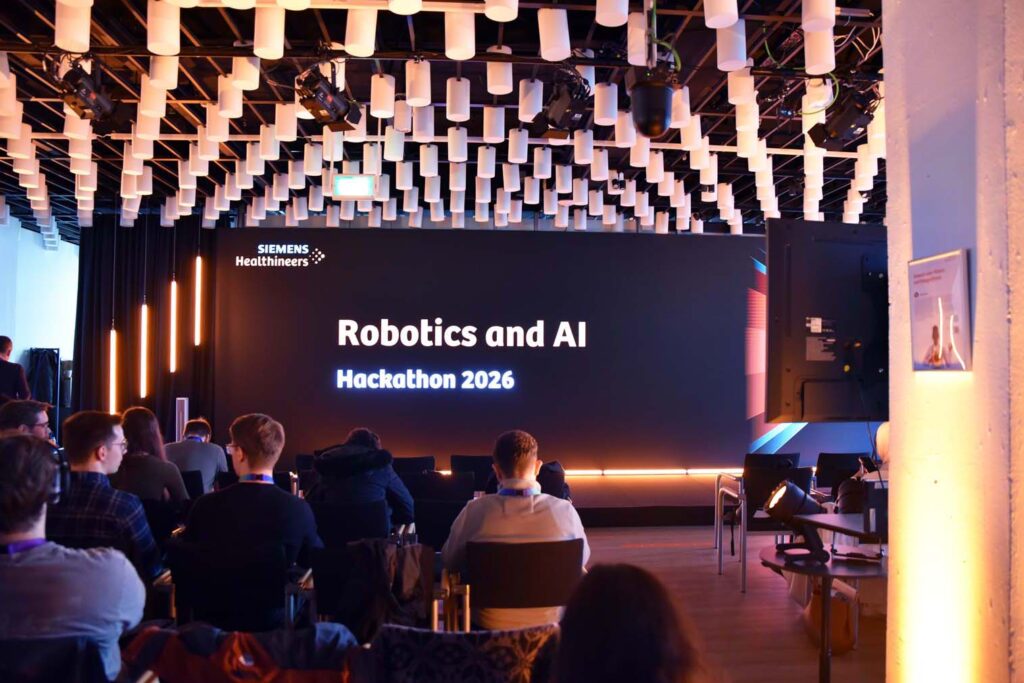
Siemens Healthineers and EELISA host robotics and AI hackathon
From October 22 to 24, the Siemens Healthineers Robotics and AI Hackathon brought more than 130 participants from across Europe to the Siemens Healthineers Innovation Center in Erlangen, Germany, to tackle real-world challenges in medical technology, robotics, and AI. Sebastian Schroth and Nicolas Butterwegge of Siemens Healthineers organized the event together with the EELISA team from Friedrich-Alexander-Universität Erlangen-Nürnberg (FAU).
“More than 40 participants traveled to Erlangen from abroad specifically for our hackathon, and overall our participants and experts represent over 27 cities and 11 countries,” said Sebastian Schroth, Technology and Innovation Manager at Siemens Healthineers, during the event’s opening remarks. “That kind of diversity is exactly what makes a hackathon thrive.” Many of the international students came from EELISA partner universities in Paris, Pisa, Istanbul, Madrid, and Bucharest. Participants came from diverse backgrounds, ranging from artificial intelligence, robotics, and data science to healthcare and marketing. Siemens Healthineers CIO Dr. Stefan Henkel also emphasized the value of this variety, noting that diverse perspectives spark creativity and enable participants to build new technologies in Europe, for Europe.
The hackathon centered on four challenges from different areas of Siemens Healthineers:
- A robotic arm designed to hand over equipment in a sterile operating room environment
- A smart robot that helps patients prepare for a CT scan
- An autonomous, image-guided control system for minimally invasive medical procedures
- AI-powered anomaly detection in automated manufacturing
Siemens Healthineers employees walked participants through real-world use cases, current pain points, existing solutions, and areas for improvement. Teams were given access to extensive datasets, software, and hardware – including a CT table – for their projects, while an autonomous robot rolled through the crowd delivering snacks.
“This is about solving real human challenges,” emphasized Amira Romani, Senior Vice President of Innovation Strategy & Ecosystem at Siemens Healthineers. She noted that in healthcare especially, innovative solutions can make a critical difference and, in the best-case scenario, even save lives. While technology itself is fascinating, she added, its potential impact on society is even greater.


Three days full of robotics, AI, and international collaboration
Over the three-day event, 30 international, interdisciplinary teams collaborated with support from mentors from Siemens Healthineers, Capgemini, and FAU. Additional inspiration came from a talk by Dr. Andreas Maier of the Pattern Recognition Lab (Computer Science 5) at FAU, titled “Vibe Coding: Software Engineering in Times of AI,” which highlighted recent advances in MRI software, among other topics.
By the second day, the teams had hit their stride, focusing entirely on their projects. “I know you want to get as much done as possible today,” Schroth said during his morning address. “But make a point of taking time for one another this evening, too. The connections you make here across borders and disciplines often last long after the hackathon ends.“
On Saturday, the final day, all teams pitched their work, with the top nine advancing to the finals to present their solutions to a jury. Alongside top managers in Technology & Innovation Management and senior software architects from Siemens Healthineers and a Senior Consultant from Capgemini, FAU Professor Alessandro del Vecchio was also part of the jury.
From medical technology to manufacturing: The winning projects
Taking top honors was a team from Scuola Superiore Sant’Anna in Pisa for ₶-SA – Precision Intelligent Surgical Agent, a solution for endovascular procedures. Alberto Anelli, Giuseppe Cairone, Alessio Naldoni, and Riccardo Panizzolo earned first place and a €1,500 prize.
Second place went to Team PatientFirst –Amirhossein Ansari (FAU), Abtin Hassannezhad (FAU), Julius Hoefer (Siemens Healthineers), Flamur Iseini (FAU), and Mats Wettlaufer (Siemens Healthineers) – who developed a robot to help patients prepare for CT scans.
There was a tie for third place, shared by Team Solo (Justin Pulapkunnel, FAU) and Team Talos—Laetitia Carli (PSL), Alp Eldam (ITU), Jiaqi Guo (FAU), Kerem Özkan (ITU), Muhammad Ibrahim Shoeb (BME), and Ege Tugay (ITU). Both teams created AI-powered anomaly detection solutions for automated manufacturing.
Connections beyond the hackathon
For most participants, the hackathon was their first EELISA activity. Not so for Shonal Fernandes, a PhD student at UPM in Madrid, whose experience shows just how lasting these connections can be. “A few months ago, I attended a ZHAW seasonal school in Winterthur, where I made friends with a lot of FAU students. When I told them I was coming to Erlangen for the hackathon, they all immediately invited me to dinner and wanted to show me around their city. Experiences like these make me feel like an ‘international citizen,’ connected everywhere and somehow right at home.”
The hackathon also gives students the chance to put their skills into practice, get an inside look at a medical technology company, and start building industry connections. Nicolas Butterwegge, who now works in IT strategy at Siemens Healthineers, knows that path firsthand: “I actually joined Siemens Healthineers after taking part in a hackathon myself, and now my colleagues and I are using this opportunity to spot new talent.”
“Through challenge-based learning we want to give students within EELISA the opportunity to dive deeper into their fields and apply what they’ve learned,” explained Victoria Goldberg of the EELISA team at FAU. “Partnering with organizations like Siemens Healthineers keeps us right at the forefront of industry developments, which is why we’re so excited about this collaboration.”
Further information:
Learn more about EELISA at FAU on the EELISA website:
FAU students, researchers, and staff can find upcoming events on the EELISA Digital Campus:
Contact
Johanna Hojer
EELISA europäische Hochschulallianz