Magnetic nanoparticles remove forever chemicals from water
PFAS, otherwise known as forever chemicals, have become commonplace in numerous everyday and industrial products. At the same time, they are some of the most problematic pollutants of our times: They are extremely durable, accumulate in the environment and in organisms and can only be removed from water with difficulty. A team of researchers from FAU, Uniklinikum Erlangen and the Bavarian Health and Food Safety Authority led by Prof. Dr. Marcus Halik from the Chair of Polymer Materials at FAU have developed a procedure to efficiently remove a wide range of different PFAS from water using functionalized magnetic nanoparticles. They have now published their findings in the journal “Materials Today”.
Johannes Voß and Linda Rockmann from Halik’s team have developed functionalized iron oxide nanoparticles with unique magnetic properties, whose surface was specifically adapted to bind to various PFAS. Once they are attached to the iron oxide, i.e. rust, particles, the PFAS can simply be removed from the water using a magnet. The scientists are taking a broad approach: Instead of concentrating on individual PFAS compounds, they wanted to find a solution tailored to work with as many materials in this highly versatile class of materials as possible, in other words nanoparticles that can specifically adapt to different requirements for water purification.
Focus on ubiquitous microplastics
The new study by Halik’s team expands the field of application of magnetic water purification to include another highly relevant class of pollutants. The researchers were able to demonstrate for the first time that the underlying principle can be applied not only to individual PFAS molecules but also to fluorine-containing microplastics. Fluorine-containing microplastics occur, for example, as abrasion from washing functional clothing, or are found in cosmetics.
The key advantage of the technology lies in the tailored surface chemistry of the particles. The iron oxide particles have different properties depending on their functionalization: The material used in the study reliably removes a broad spectrum of PFAS even from water samples contaminated with diverse substances and organisms, such as laundry wastewater or river water. Other iron oxide nanoparticles which Halik’s team worked with can be regenerated and reused multiple times after magnetic separation. Additionally, the iron oxide particles are scalable and non-toxic.
“Our technology bridges the gap from molecular pollutants to microscopic particles and underscores the potential of functionalized iron oxide nanoparticles as a versatile and sustainable platform for water treatment, even for samples contaminated with a complex mixture of pollutants,” explains Professor Halik.
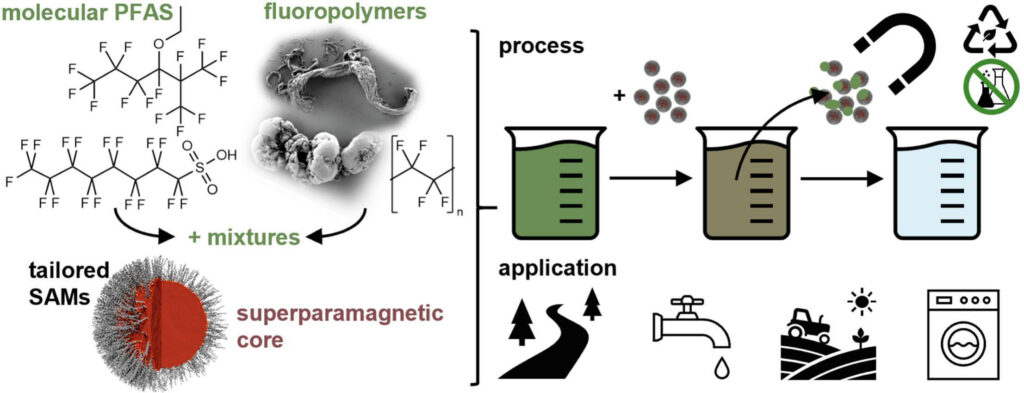
To investigate the water purification performance of surface-functionalized nanoparticles, researchers examined a broad selection of different pollutants known as “forever chemicals”, or PFAS (per- and polyfluoroalkyl substances). These include both neutral and charged molecular pollutants (molecular PFAS) as well as perfluorinated micro- and nanoplastics (fluoropolymers). Selectively modifying the nanoparticle’s surface enables specific interactions with the contaminants.
During the purification process, the custom-designed nanoparticles are added to the water contaminated with the PFAS. They bind the pollutants to their surface and can then be removed from the water as contaminant-laden nanoparticles using a magnet.
The selected pollutants can be efficiently removed from various water sources, both individually and in mixtures. These include, among others, uncontaminated water, river water, drinking well water, soil leachate, and wastewater from washing machines.
These nanoparticles offer a recyclable, sustainable, and scalable application in water treatment.
(Figure: Linda Rockmann, Johannes Voß)
Success in real-world applications
The researchers were particularly keen to demonstrate that the method also works outside the lab. Therefore, the team tested the technology on a real contaminated drinking water source, river water, wash water from soil remediation, and wash water from washing outdoor textiles. In the process, they succeeded in reducing PFAS concentrations from a contaminated drinking water source by 87 percent, falling below the new German limit of 100 nanograms per liter. Additionally, fluorine-containing microplastics were successfully removed from the water using magnetic separation.
Prof. Dr. Marcus Halik
Chair of Polymer Materials